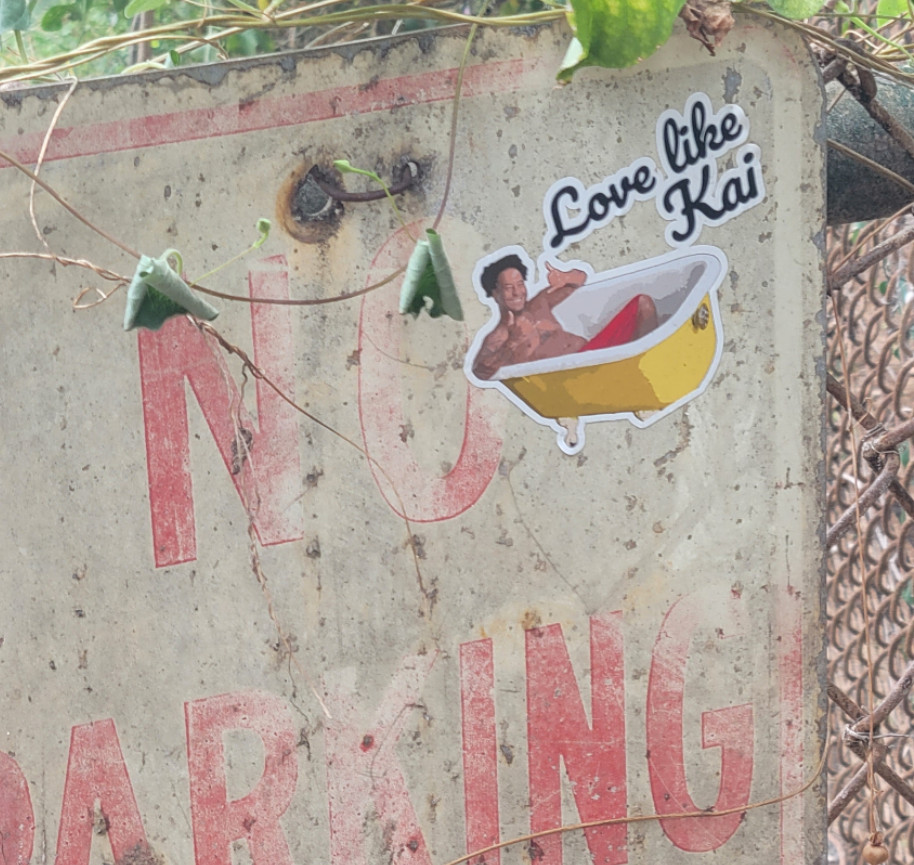
The idea should have been simple. A basic assignment for a sociology course on human geography. Go to a place, observe it for a half hour, three times. It should have been easy. Just go to the Waianae Store and walk around or something.
But that’s not how this is going to go.
I’ve been waiting for this trip since the day it happened. Three weeks ago, today. It’s 9:30 a.m., Friday the 31st, and right now—if things had gone differently—Kai would be calling Dustin, or maybe just texting him. Arguing, negotiating, whatever it was. Trying to get Dustin’s piece. Or at least that’s what we’ve come to assume. It's never clear with Dustin. His pidgin is thick, dense, indirect, leaving things open to interpretation even when it's not about something this heavy.
"Of course I’ll back up brah, but I need to know what getting into. I’ve got a family to protect, yo."
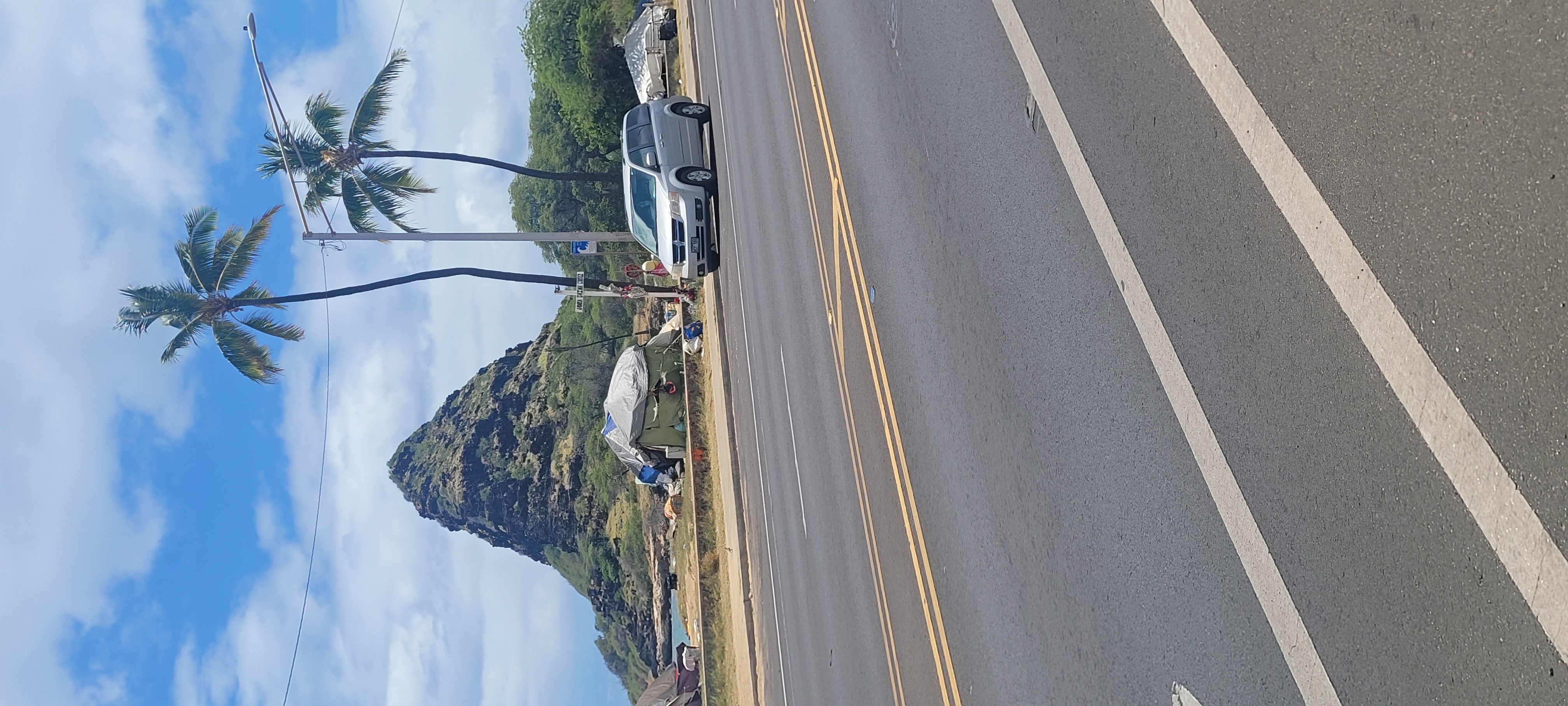
A mountain standing out from the sea, Lahilahi; A camp by the beach. A cross, a memorial, a shrine.
But as far as we can put together, Kai couldn’t get what he needed from Dustin, whatever it was.
So soon, soon it would be the day. The day I go to Lahilahi. Maybe I’ll find something there. Maybe I won’t. Maybe understanding is irrelevant. Maybe all this—sociology, ethnography, the obsessive parsing of events, words, memories—is just a culture too obsessed with the smell of its own farts. But still, we go.
Lahilahi is a promontory on the west side of Oʻahu. It’s the place where Kai decided to end his life.
"Are you ready to move on?" she asked.
Only if you make me.
No, we wouldn’t just be going to Waianae Store and picking through racks of Korean chicken foot potato chips like lost tourists in a thousand-acre hood. Kai brought those home once. We tried them on the porch. We already know what they taste like. They taste like chicken feet.
No, this isn’t going to be some clinical sociological exercise that pretends to reject objectivity while reinforcing it at every turn. This isn’t about checking a box, writing a paper, getting a B- and moving on. This is gonzo. This is from the heart. This is in service to Kai’s memory.
Kai, the Hawaiian man who built a family when his own had rejected him. Who held his community together with a heart too big for one lifetime.
So he had gone chronic a few times. Who hasn’t? Hell, I lived under a bridge once. Smoked with punks on train tracks. Life loops around, and who you were once doesn’t mean you’ll be that person forever. Sometimes you ride the wave, sometimes you’re under it.
"All I’ve got is love now," Kai would say.
So for this assignment, we’ll make that journey. I’m going to the rock. To the place where Kai died. Three weeks ago today. I’ll go there three times. At least. Eventually, I suppose, I’ll be going every week, bringing flowers, once we get the shrine built.
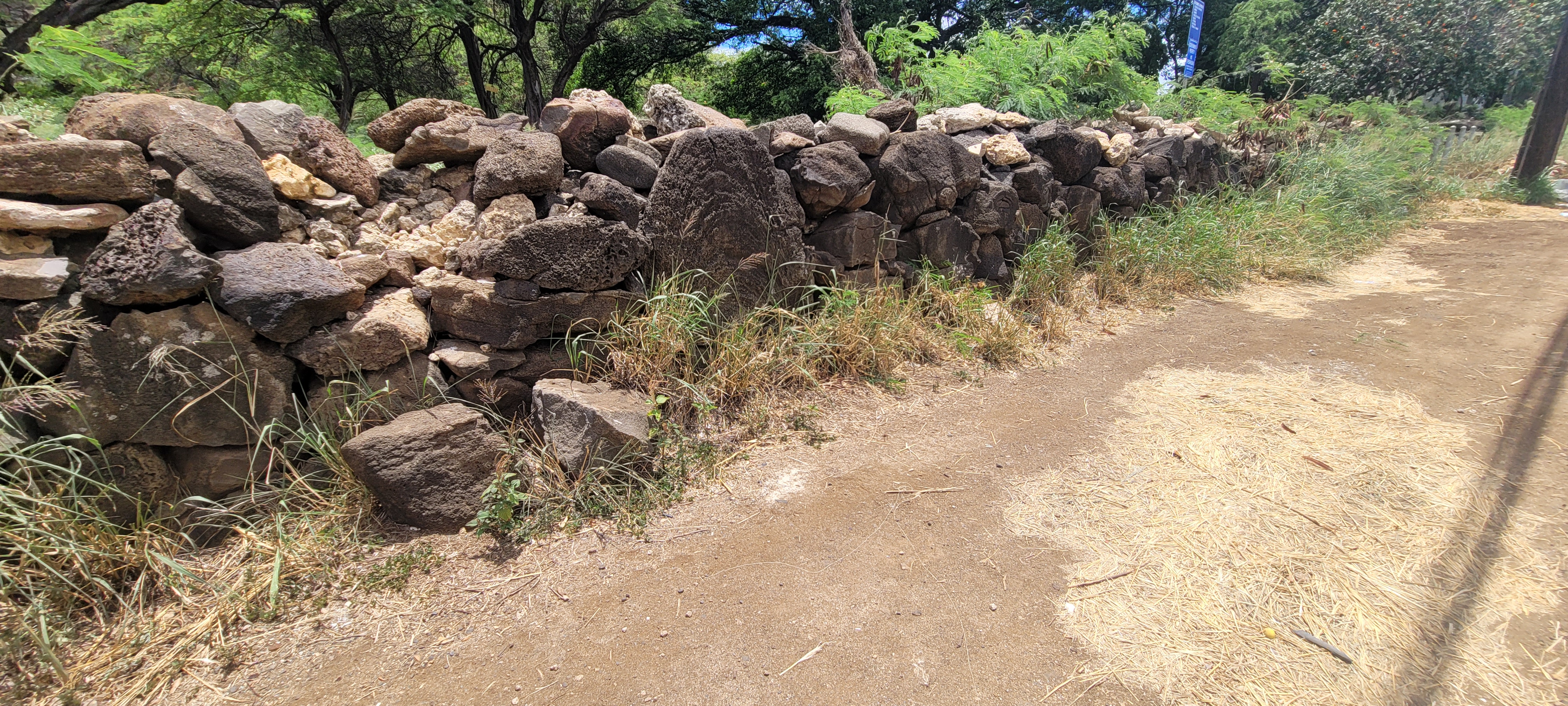
The last time Hayley and I tried, we were stopped by the wall.
When I saw it, it hit me like something out of Le Guin’s Tehanu—the wall between this world and the next.
The wall which surrounds Lahilahi. A stacked mossrock Hawaiian wall, with large stones.
It’s big, coarse, rough-hewn. Not a thing built, but a thing left behind.
Not like the small, mortared moss-rock walls you see, neatly canted and civilized. No, this wall is something else. It follows all the same rules, but its reason for following them is entirely different.
Like Kai. Like all of this.
Soon enough, it will be time to go up to that rock. But for now, maybe I can give myself another day, maybe another week. I’ve got no handle on any of this. I don’t know what ethnography is. I don’t know what Kai’s death means.
But if I’m going to do this, I need to figure out what it is I’m actually doing. What does it mean to tell this story? To go to that place, stand where he stood, and come back with something more than just silence?
I don’t want this to be some bullshit sociology exercise—detached, sterilized, picked apart like a corpse on a lab table. I don’t want to be just another outsider taking notes on someone else’s grief.
Maybe that's why I keep circling back towards gonzo. Gonzo is process. Gonzo doesn’t attempt to break down the wall between self and subject. It torpedoes it; blows it apart. It doesn’t dance around issues like relativism or objectivity. It confronts them head on. Steven C. Fedorowicz talks about ethnography as something lived, something you become instead of just observe.1 He pulls from Hunter S. Thompson, from performance theory, from the idea that the line between participant and researcher doesn’t just blur—it dissolves.
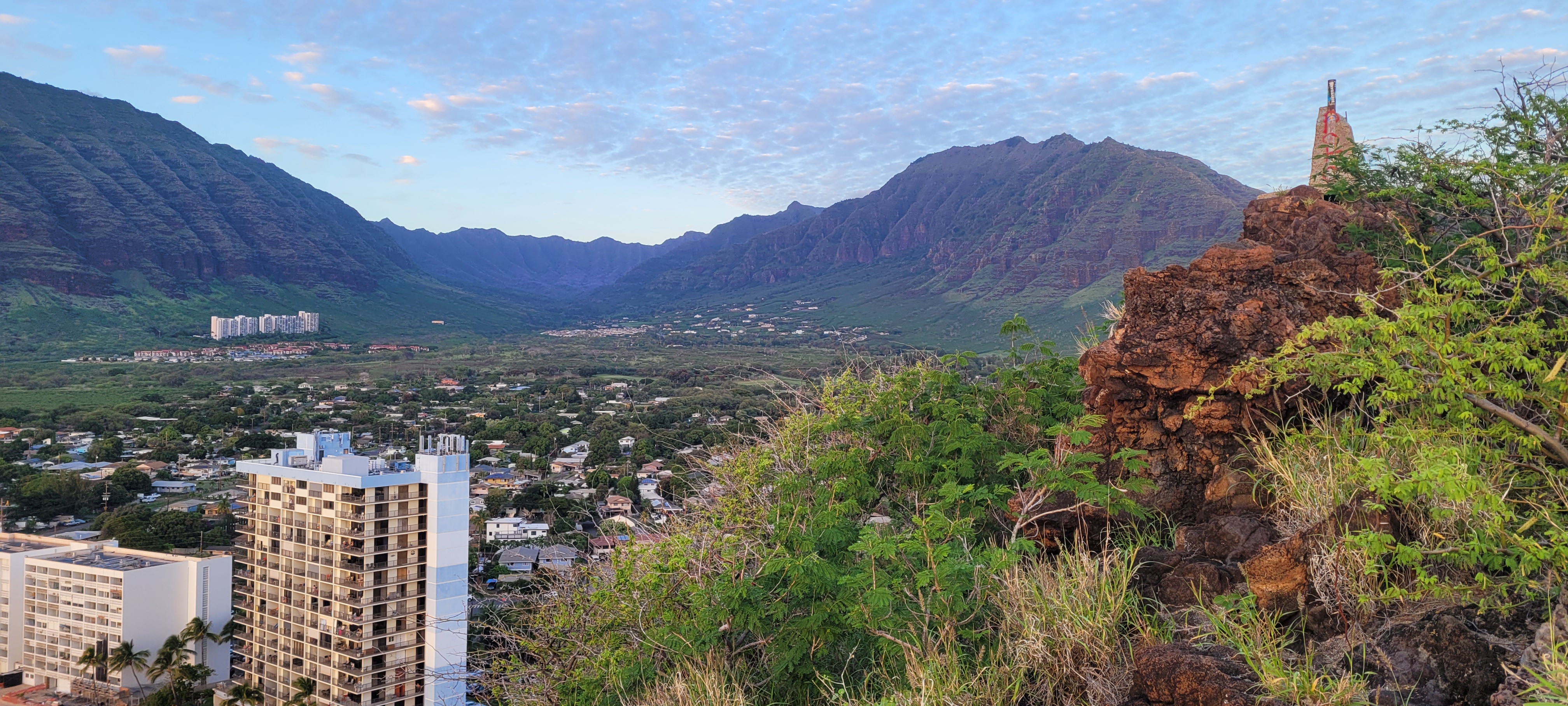
Mākaha valley, seen from the top of Lahilahi.
Is that what I’m doing? Is that what I should be doing?
If I’m going to make this trip, I need to know how to tell this story. And maybe, just maybe, Fedorowicz has something useful to say about that.
Packing up
If traditional ethnography is about studying people from the outside, gonzo, to go gonzo, is to be the subject of your own study, throwing yourself into a thing. There is no pretense of distance, no halfhearted attempt to straddle the line between observer and participant. The goal isn’t to acknowledge the line, the goal is to blow it up, to burn it to the ground. And this is the point of Towards Gonzo Anthropology: Ethnography as Cultural Performance.1
I’ve been living on the west side now for five years. I’ve made friends and built my ʻohana from the people I’ve met in my time here. But there is still a wall, a barrier that is present between me, a haole, a transplant – and the people of the place, those who were here before. That wall, like the wall at Lahilahi, is like the wall between observer and participant, between self and other, between here and where is beyond.
Immersion: No Safe Distance, No Neutral Ground
Gonzo rejects the false comfort of neutrality. In a traditional model, you might try to maintain critical distance, balancing the tension between insider and outsider. But in gonzo? There is no safe distance. You can’t stand on the shore and write about the storm—you have to jump into the waves and hope you don’t drown.
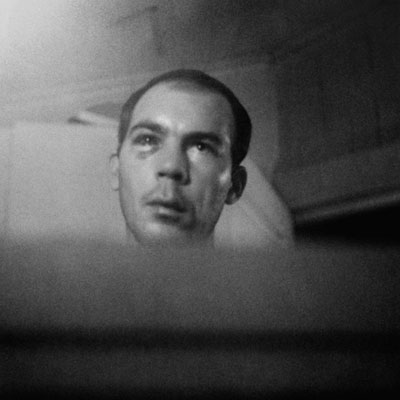
Hunter S. Thompson, after his beating recieved from the Hell's Angels.
Hunter S. Thompson was one of the first to use this approach in journalism—riding with the Hell’s Angels, swallowing their world whole, only to get stomped by them when he got too close.2 Fedorowicz applies the same logic to anthropology. He describes his own fieldwork as an act of complete immersion—from embedding with Hare Krishnas in San Francisco to navigating the social dynamics of Japan’s deaf community. In each case, he’s not just writing about the culture; he’s inside it, interacting with it, letting it shape him as much as he shapes his observations.
Blurring the Observer and the Observed
One of the core ideas of gonzo is that you can’t study something without affecting it. The researcher is never invisible. Your presence, your biases, your relationships—they all alter the reality you’re trying to document.
Fedorowicz doesn’t try to erase that influence. He leans into it. He argues that good ethnography should be multivocal, meaning it doesn’t just filter experiences through the researcher’s perspective—it lets the people within the culture for themselves. Their voices, their lived realities, their narratives take center stage, instead of being refracted through an academic lens that warps them into something unrecognizable.
So What Does This Mean for Me?
I keep coming back to this because I’m not just trying to tell a story—I’m trying to figure out how to tell it. Do I stand at the edge of Lahilahi, take notes, and observe from a comfortable distance? Or do I let myself get swallowed by the place, by the weight of what happened there, and let whatever comes out be the only truth I can tell?
If gonzo is about breaking down the wall between self and subject, then maybe this is the only way forward. Maybe this isn’t just an academic exercise, a sociology requirement. Maybe this is what the work actually looks like.
Because in the end, Kai’s story isn’t some distant thing to be analyzed. It’s already part of me. And maybe that means I have to tell it from the inside.
Does His Approach Fit?
Fedorowicz argues that ethnography is always a performance, whether researchers admit it or not. He takes aim at the illusion of objectivity—the idea that an ethnographer can step into a culture, study it, and walk away unchanged. There is no neutral observer, he says. Once you enter the field, you’re part of the field. Once you tell a story, you’re shaping the story.
Because I’m not here to study Kai’s death. I’m not here to document it for some academic record, to turn it into data points or theoretical analysis. I’m living through it. There’s no researcher-subject divide. No “critical distance.” Just the weight of loss and the mess of trying to make sense of it.
But maybe that’s exactly why Fedorowicz’s argument matters. If gonzo is about throwing yourself fully into the experience, the moment I decided to write about it, I became both the observer and the observed. The moment I started retracing Kai’s last steps, I wasn’t just remembering—I was participating.
Fedorowicz would probably say that’s the whole point. That there’s no separating the work from the person doing it. That whether I like it or not, this is its own form of gonzo ethnography.
But then again, there’s a difference between immersion and grief.
Gonzo is about getting inside a culture—living it, breathing it, letting it reshape you. But what happens when the culture you’re immersed in isn’t an external world but your own loss? When the story isn’t something you’ve stepped into, but something you’ve been thrown into, unwillingly?
This isn’t about “going native.” This isn’t a temporary descent into another world before climbing back out with a finished field report. There is no climbing back out.
And that’s where I wonder if gonzo actually fits. Can you perform the role of the participant-observer when you were never given a choice about participating in the first place?
Fedorowicz would say yes. But I’m not so sure.
The Problem with Gonzo (and Why It Might Not Matter)
Fedorowicz builds his gonzo ethnography on the foundation of Hunter S. Thompson—loud, chaotic, reckless, drug-fueled. But that kind of gonzo is about chasing the story, not carrying it. It’s about tearing through experiences at full speed, about immersion as adrenaline, about throwing yourself into the fire just to see what burns.
And sure, I can be loud. The west side can be loud. The wind whipping across Mākaha, the roar of the surf, the sudden crack of an argument turning into something heavier in the parking lot. It’s all big, brash, unforgiving. But loud isn’t the whole story. Not Kai’s story.
Kai was the kind of guy who could talk story, pulling you in with the gravity of everything he had lived through. And he had lived through so much. The first graduating class from the Hawaiian immersion school, Ke Kula Kaiapuni ‘O Ānuenue. Traveling between New Zealand, Arizona, and Washington D.C. as a teenager. Getting in trouble with tribal elders in New Mexico, only to find himself smoking weed with the chief’s family that same night. The kind of contradictions that only life—not theory—can produce.
Kai, and family.
He told us about the abuse. About how his own family rejected him. About growing up wild, burning down cars for fun. About how he went to jail. And how he came out of it, only to repeat the cycle—abusing his own kids, ending up behind bars again. Two times Honolulu Most Wanted.
And somehow, through all of it, he found his way to Mākaha. To Mike. To Aki’s. To the waves where I met him.
So no—this isn’t just another wild gonzo thrill ride. This isn’t about spectacle. This is about weight.
And that’s what makes me question Fedorowicz. Is gonzo even the right tool for this kind of story? For grief? For loss?
Gonzo works when you’re in pursuit of something. But what happens when the thing you’re chasing is already gone? When the story is about absence, not presence?
Fedorowicz might argue that gonzo is the way to tell this story. That throwing yourself into the weight of it, refusing to separate yourself from it, is exactly what makes it real. That objectivity is a lie, and the only way to do this justice is to be in it fully.
Maybe he’s right. Or maybe this is something else entirely.
Either way, I’m not chasing a story. I’m carrying it. And that’s a different thing altogether.
What You’re Keeping, What You’re Leaving Behind
Does Fedorowicz actually help? Or is this just another academic exercise—another attempt to theorize the ineffable, to carve something massive and raw down into digestible, peer-reviewed bites?
I don’t know.
Maybe gonzo is the right approach. Maybe rejecting objectivity, rejecting the detachment, is the only way to get at something real. Maybe this whole project—the writing, the going, the remembering—is exactly what Fedorowicz is talking about.
Or maybe none of that matters.
Because at the end of the day, this isn’t theory. This isn’t method. This is grief. This is Kai. And Kai isn’t a case study, a subject, a data point in a performance of cultural immersion. He was my best friend. And he lived a life. A big, complicated, messy life.
A life full of waves and movement. Of mistakes and second chances. Of loss, of love.
So maybe, in the end, all that matters is what Kai would say:
"All I’ve got is love now."
Fedorowicz can have his theory. I have the reality.
But if theory is just another tool, maybe this is the one that lets me tell this story on my own terms.
And that’s enough.
Who is Kāhea?
It's 6AM and the light is beginning to crawl across the sky. Another night and I didn’t sleep. My anxiety is high. Higher than it's been in months. I didn’t sleep, again. I think of it as staying up with Kai now. It seems better that way.
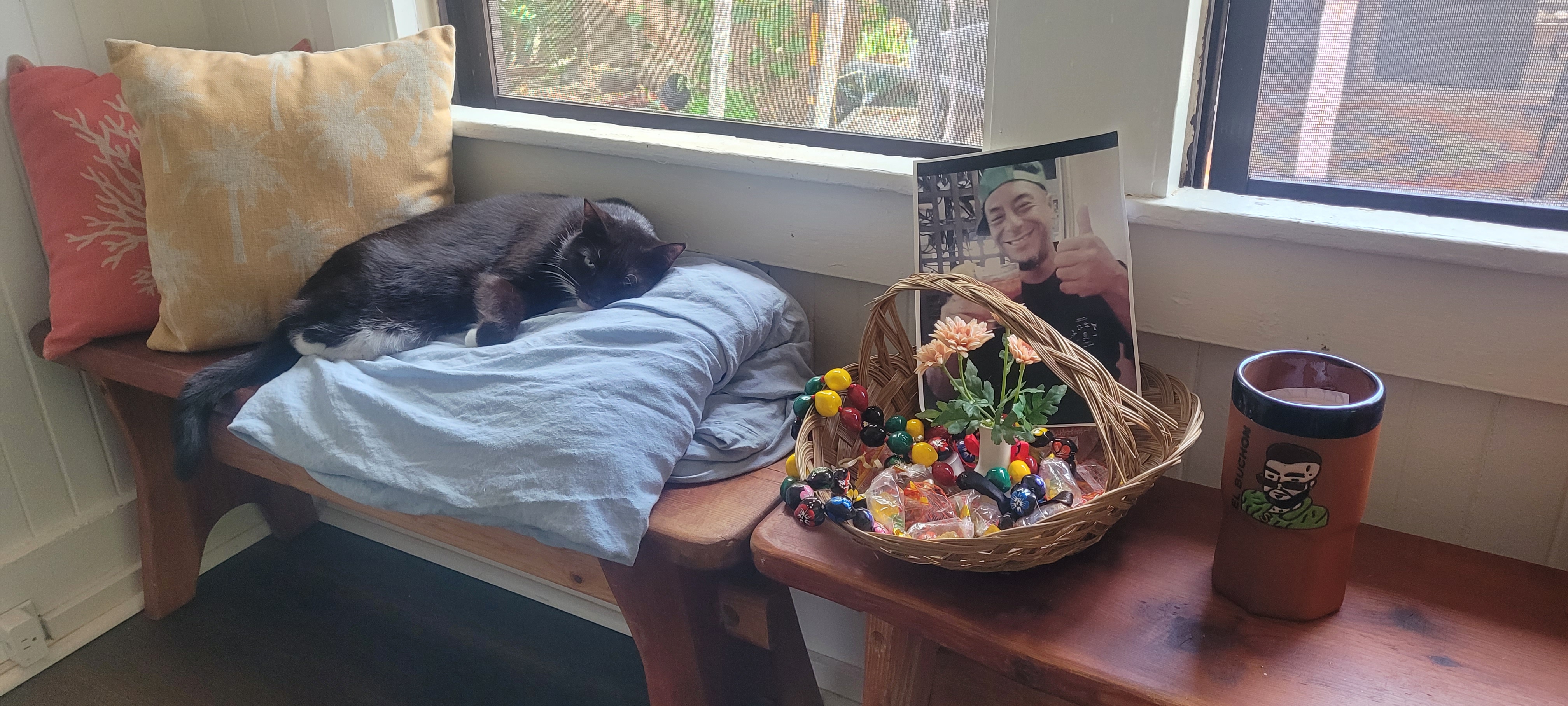
It's Saturday. And the day has come. I couldn't find a black shirt. We’re at our house in Mākaha. I’m sitting in the room which was the room Kai spent his last night alive. It's still arranged how Kai had it set up. We’ve still got a few of his things, some hats. Some work shirts. We’ve put together a basket of lei with a portrait of Kai in it that follows us around the house.
My eyes feel like they have sand in them. My head is thick like mud between my ears. Two screens, forty tabs, pages of notes. Not one word written for Kai. Why the fuck did I choose to do this project? Mākua. Poverty. Pu‘uhonua o Wai‘anae. My skin is crawling, my anxiety has peaked so high. I’m supposed to deliver a eulogy today.
Kaumaha—the “heavy weight” of grief.
I’ve put on weight since Kai left us. No, that's not right. I’ve gotten fat. Fatter than before at least. That first few days and weeks, I swear I lost like 10 lbs. I’ve put on that plus more since then. Threw myself into the work. Maybe to avoid shit. Maybe to avoid other people. Everything is so cold. Everyone has become so distant. There is the world. But it seems so far away. From what I understand it's on fire.
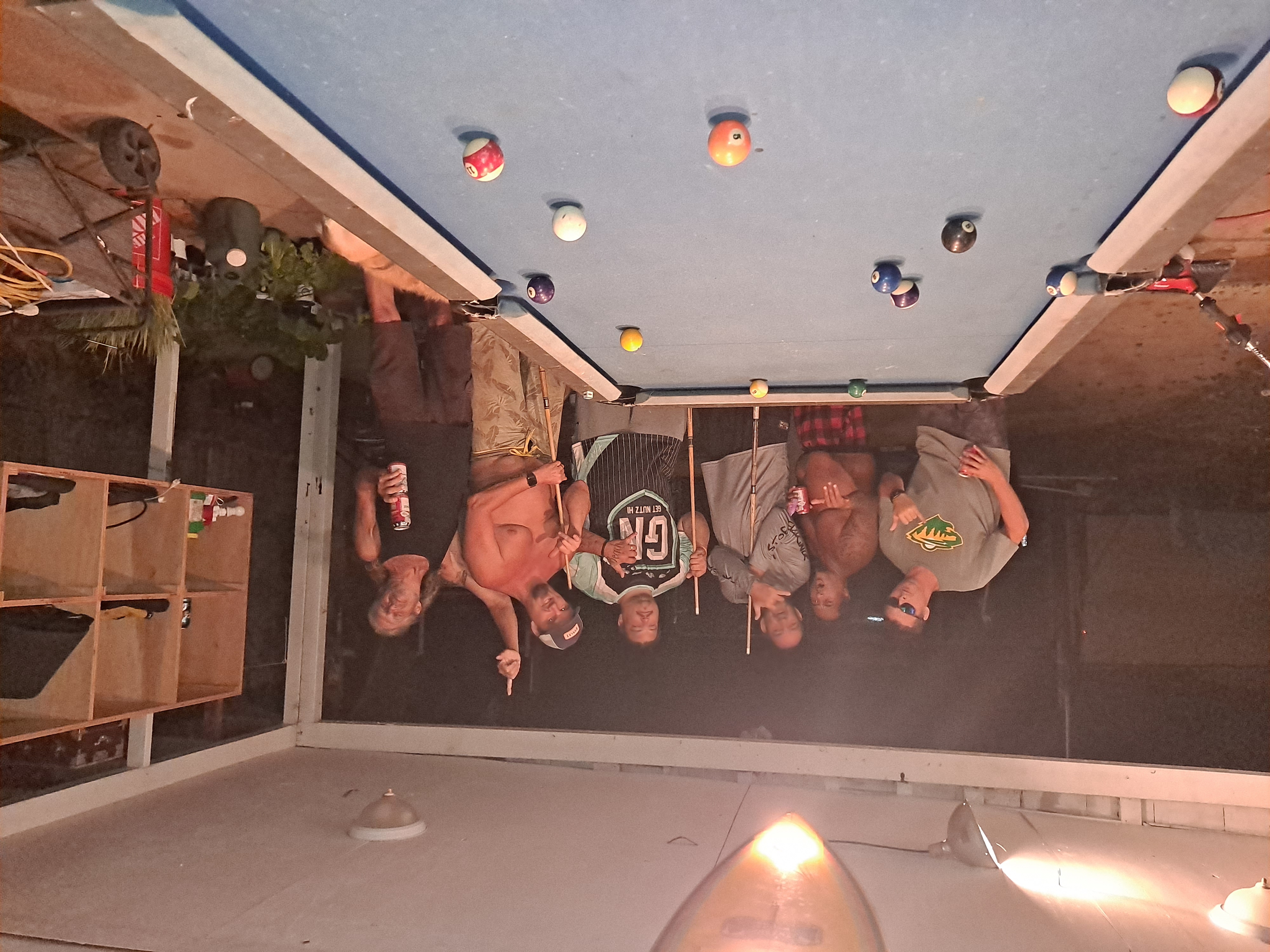
From left to right, Skinny Adam, Kai, Big Adam's dad, Big Adam, Bruce, and Mike.
I don’t know who shows up today. I know Bel will be there. I know Mike. Maybe Kalani. Kalani should be there, but he’s been a total stranger this last month. But then so too have I. Adam, Big Adam. I told him when it was going to happen.
I texted Big Adam yesterday. He’s not going to make it. We haven’t had one of our yodels on the porch since December. Since before.
Hayley and I talked about not going. We had a trip planned for my birthday to Kauaʻi. But that's cancelled now. Kai’s family organized this. We felt like this was too important. We put off the trip. I feel obligated but that obligation is conflicted. Pulled by social obligation when you’ve got this ghost telling you something else. Showing up for our neighbors, who spent the most time with him. Trepidation. Worry. Waking up with a feeling of dread. But resolution.
Kai’s celebration of life. Kai’s family organized this. But Kai chose his own family, a different family. Kai grew his own ‘ohana, when the one he was born into rejected him. And we were that. An alternative ‘ohana. An ‘ohana of one's own choosing, of those who accepted him as he was. Getting pushed out of the family one is born into, and then making one of your own.
Kai had words to say about his family: “Strong culture, Weak people.”
Kai remade his family of his choosing many times over throughout his life. When we knew him, he had gravitated to the shoreline near Upena and Moua Streets. There, neighbours, surfers and kupuna, became his people—sharing sunsets, naming the honu that frequented the beach. Bitey, and big Mama. Potluck meals at all the neighborhood houses. That circle, not blood relatives, carried him until his end.
Hayley and I sat down a few weeks before to put down some words on the matter. The first thing Hayley said she thought of about Kai was the way he greeted people every time he arrived at Aki’s beach. He would get there, scan the shore and just go up to every single person and greet them and, whether he knew them or not, by the end of his time there, he would know them, and they would know Kai. He would just move around the beach with this huge smile on his beautiful face.
From front to back, Bel, Delia, Eileen, Kai, Hayley.
Hayley pointed out that Kai made a point to cut most of his family out of his life. He had a lot of family in Māʻili, a family that he didn't necessarily interact with. In Hayley’s words, maybe there were some family connections that he either wanted to not maintain or specifically did not want to maintain. In Kai’s words, he said they were dead to him.
Remembering back to his daughter's graduation from high school, Kai wasn’t sure he wanted to go. He didn’t want to put himself in a situation where he saw his family because he didn’t know how he might react, and he was afraid he would react violently.
But when it did come time for Honu’s graduation, Eileen and Bel went down there with him. So he had us, the ʻohana of his choosing, to back him up that time. And Kai got to see her walk, congratulate her in person. And no blood was shed that day. Of course we don’t know all the details of the background and history, but Hayley said that the Kai we know was a guy who wanted to support his daughter, so it was really important for him to be there for Honu on that day.
And so we canceled our trip to Kauaʻi. I’m supposed to speak today. My eyes are dry and tired. I’ve got no words written for Kai yet. I’m so tired.
‘Ohana. ʻOha. ʻOha are the little shoots that push out from the main corm of the kalo plant, each one its own stalk but still tied to the same root. Hayley read us the legend of kalo—Hāloa—was the older brother, the story goes, so every new sprout is family, too. The friends, we hānai, the folks who weed the patch beside us, even the dirt that keeps the water steady. If we grow from the same root and feed one another, we’re ʻohana.3,4
Twinkle Borge, founder of Puʻuhonua O Waiʻanae.
Isn’t that what Twinkle Borge did? Twinkle Borge, the matriarch of Pu‘uhonua o Wai‘anae, a village of almost two hundred people who made the space between the Waianae boat harbor and the highschool their home, a ramshackle buildup of pallets and sheet metal roofs create a barrier between it and Farrington highway. It’s got its own bus stop. Pu‘uhonua o Wai‘anae was a refugee camp for those who either had no family, willing or remaining, to take them in. Like Kai, Twinkle built her ‘ohana around her.5,6
If it wasn’t for Twinkle, Pu‘uhonua probably would have been cleared by the police years ago. But Twinkle put wāhine in charge (with beating sticks, from what I’ve heard), a matriarchy of block captains who enforced a “no drugs, no stealing” form of safety.7 What became was a center of mutual aid, and aloha. A home to call their own.
People who would show up at Pu‘uhonua, they would get a tour, and whatever they needed to survive.6,7 Pu‘uhonua isn’t charity. Pu‘uhonua is doing what you need to do to survive, because one's survival can not be criminalized. Pu‘uhonua is the family of one's choosing. Its anarchism, the kind of organic emergent anarchism I lived when I was homeless. A social system of tending the gardens, keeping an eye on the keiki, sharing whatever you have with whoever needs it. The anarchism of doing the dishes or taking out the trash.
Others have talked about how Pu‘uhonua saved them. People like Layla – a māhū (trans) woman who had been ostracized and even abused in mainstream shelters – could finally “live free of such violence” and be accepted as ‘ohana at Pu‘uhonua o Wai‘anae.8,9,10
Hayley comes in and asks if I’m going to get ready. It's 9:30. I’ve got a funeral to go to. I’m giving part of the eulogy. I haven’t written anything yet. The rest will have to wait.
Hayley is putting on a simple black dress. She’s wearing her engagement ring. I got her that in Mexico. Another place that puts its embrace of death on display.
I couldn't find a black shirt. The years go by and I’m down to one. It's grey, but if I roll the sleeves up, it looks nice enough. I found an old t-shirt. It's from some surf tournament a while back but I never wear it because I pretty much only wear tank tops. I cut off the sleeve, and pin it together into an arm band with some safety pins I found under the sink.
I hadn’t taken the time to talk through what we were going to say since we were asked to speak.
Hayley starts talking about what we were going to say. She asks if I have anything written. I’m still sitting in Kai’s room. Nothing has moved since the day his sister came to take his stuff. Like how I order. I never look at the menu. I had some notes on my phone but no real sense of what I was planning to say.
Being in this room. We had just started talking about what we might say. Bel came in asking if she could clean in here. It seems right. It seems right that Kai’s room should be cleaned for him today. Even though he had few things, he always kept them clean, organized. We moved out to the gazebo, talked for maybe half an hour, hour.
Hayley shares what she had written out. It's good.
I hadn’t written a word yet. I had lots of thoughts but not ones I was sure I wanted to share with the family. There were things Kai said. Things a person made of love, like Kai was, would never say. Kai’s love was like a weight suspended high, so high, at the end of a long pulley, brought high by the weight of some deep thing he carried around. This is the weight I know is present. That weight brought Kai down. And now it's mine to carry, even if I’ll never fully understand it.
You’re gonna carry that weight.
We get into the car And we began the drive to Māʻili beach park. Saturdays on the westside are supposed to be for beaches, birthdays, and barbecues. And Māʻili beach park is a favorite spot, with grassy sands and big flat spaces. Expecting maybe thirty or forty people, maybe fifty. I expect most of the neighborhood to be there.
Coming around the corner to see already hundreds gathered, and almost no parking in all of Māʻili park. There are no other tents in the park. All of the street parking is filled. There are no other tents in the park. There is one pavilion in the park. It's massive. Four times the size of any canopy I’ve seen set up before. How are there no other tents in the park?
We arrived before Bel. We drop off Eileen at the entrance and circle back to find parking. We somehow manage to get the last spot in the parking lot, next to a pastelle vendor. They seem confused. Obviously what is going on is interrupting their business. Nothing stops the hustle out here.
Hayley and I begin walking up, and we see no one we recognize and are not recognized. It's almost all Kānaka maoli. But not a gathering of forty or fifty. There are hundreds of people here today. Looking out towards green lanterns, it's a clear day but the sets are coming in from the south. The whole park seems simpler, clearer than before.
The pavilion they’ve set up is massive. Seats like pews in a popup church. Four big tents, each bigger than I would have expected, all strung together. From a family that didn’t talk to Kai. Didn’t want Kai, what was all this? Who are these people? Who is Kai? Vernon “Kāheaokekai” Na'auao. Kekai420.
Honolulu’s Most Wanted. Twice.
They’ve set up a separate tent for checking in and we walk up to sign in. Still, no one recognizes us. The aunties checking people in do a double take at our names. Look down, and look up at us. We got haircuts yesterday. The couple wearing double mohawks sometimes throws people. It's the same mohawk I would give Kai when he asked to have his hair cut. Skin on the sides and dreads on top for Kai. His two tattoos “as above” on the left, “so below”, on the right, would pop afterwards.
The auntie managing the booth asks “Oh are you Kai’s friends? Are you the ones speaking today?” We confirm our names and the auntie gives us each a program.
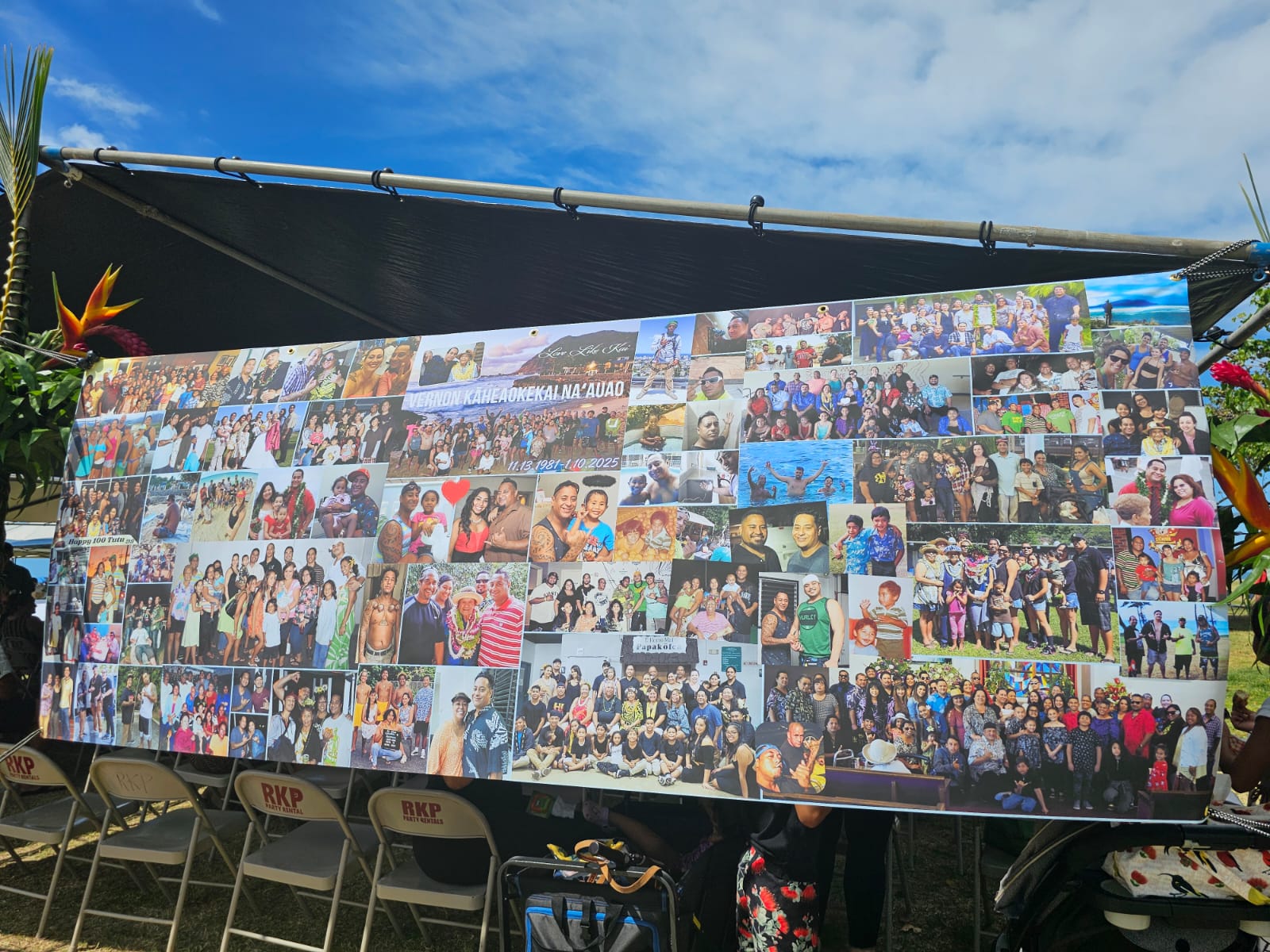
A banner mosaic of pictures from Kai's past.
Walking to the back of the pavilion, there are two banners, each with hundreds of pictures. Most are from Kalei, Kai’s sister. It's pictures of Kai, with his kids, his wife. Pictures we shared with Kalei. Some pictures from his childhood, but so few. Most are Kai in his twenties and thirties it looks like.
Filtering through the crowds to find his sister and his mom. A sea of retainers around them. A drawing retinue of people offering their condolences. As we approach, there is a subtle tension in the air. The mother recognizes us. The father seems oblivious. But Kalei, Kai’s sister approaches and breaks the tension. Kalei was always good to Kai. She always looked to make sure he had food. Would bring a whole car of groceries for Kai to make sure he was eating.
“I’m so glad you could make it. Are you still ok to speak?” Of course. But I’m not. I still haven’t written a thing. I need to sit down and at least get some notes together. Donuts and water are available at a tent on the side. We haven’t eaten yet. It's hot. I should eat. And more coffee. Aloha and Anthony were there. It's good Anthony is here. He missed the remembrance we had for Kai on the beach.
He had to find out about Kai’s passing from Bel, at the convention center, when they found each other working the same event. I know he took it hard finding out that way. I had been holding off on telling him, since it was an open secret that Anthony was back in rehab.
I’m jotting down notes and thoughts as we proceed, but my nervous energy has heightened to a fever pitch. I can feel this well of panic, pooling up below my throat. I haven’t slept. I’m strung out on coffee and sugary malasada. I can feel my fingers twitching as I thumb this into my phone.
The whole pavilion is filled. I’m counting chairs. I should be writing. Ten per row. Twelve rows per section. Four sections. About eight seats per section filled. People with their own canopies all around the outside. Maybe three hundred, maybe four hundred under the canopy? Another hundred outside?
Each tentpole in the pavilion has a lei wrapped around it. One of the most intricate lei i’ve ever seen. Torch ginger. Fern. Uluhe? Tied ribbon. No expenses spared.
I’ve been looking down too long and I don’t notice it till suddenly it's upon me. Never turn your back on the ocean.
Chant, an oli begins. Suddenly the whole crowd is standing up in unison. The ceremony has started, Hayley and I, with the rest of the neighborhood, are sequestered in a deep corner of the pavilion. At the front a choir begins to sing. A choir of children? This is Kai’s old school. I knew he grew up going to Hawaiian immersion school. One of the first. Is this them?
It's a beautiful song that lasts until a version of what I think is the Lord’s prayer begins.
‘Amene. And the crowd sits back down.
Two of Kai’s cousins are acting as MC’s. The begin the retelling of Kai’s childhood. Kāhea. Do they mean Kai? Who was this Kāhea?
Back last year, when he had his last attempt. That time Mike found him with a belt around his neck. That's when he came to live with us. I filled out his temporary disability for him. His government name is Vernon. Kāhea?
His friends from school. Stories of ditching class. Kāhea dragging his classmates down to the bowling alley. Calling him Kāhea. I knew his Hawaiian name. Kāheaokekai, but I had never heard anyone call him Kāhea. At least I never heard Kai call himself Kāhea. Always Kai. And I saw him introduce himself to a hundred people, day after day, down at Aki’s. Kai called himself Kai.
A fire at the family home that would take all of the photos the family had of Kāhea. Who were these people and this person they knew? Over and again, these people. Kāhea. The friends and family of Kāhea. They hadn’t spoken or had contact with him in eight, twelve, fifteen years?
They loved this person, Kāhea. But it was not the person who introduced themselves to me. Not the person I met in the lineup at Aki's.
And it's my turn to step up and speak
Hayley and I step towards the podium. I’m in a fugue state. I don’t know what's happening. My feet move of their own accord.
And suddenly I’m facing a sea of faces. All faces with a hint of Kai’s look in them. His daughter, Honu, was there on one side. Those eyes. Kai’s eyes.
Will I be talking about Kai? or do they expect to hear about Kāhea?
I step up to the microphone.
“You call him Kahea, but when we met him, Kai was the name he gave us”
“It was when Kai came into our life, he taught us what family means. He didn't explain it with words, but he showed us every day through action. What Kai had was only love. He said that in this new world he had created around himself, that there was only love, and because he filled himself with only love, his world was filled with beautiful people”
“Surfing together at Aki’s beach was where we met, but between karaoke nights out on the porch, gingerbread house disasters—we didn't just make memories, we built a life around those moments.”
“Kai took care of everyone around him. Kai always had his eye on the swimmers and surfers at the beach, especially the keiki. He saved lives more than once. On more than one day, I followed his lead to rescue the surfers together. There were so many more days he quietly kept our community safe.”
“If something needed doing, Kai didn't wait—he made it happen. Electric problems at our house, outlets we didn't know we needed, he just took care of it. When our friend needed work done, would help with the neighbor's electricity.”
“When it was a stranger, a customer, who at Christmas couldn't afford the repairs, and wouldn't have lights to open presents with. He made sure they had their lights back on in time for Christmas. He didn’t ask anything in return from those who couldn't afford it. That’s who Kai was.”
“Two Christmases ago, we had a gingerbread-making contest. There’s a video somewhere on YouTube, all of us covered in frosting, proudly crafting some truly terrible gingerbread houses. That's exactly the kind of messy joy Kai brought into our lives.”
“He sang "Strawberry Wine" on the porch for my 40th birthday. He helped build our new bed when Hayley and I went to New Zealand, even replacing our mattresses. And yes, there was that one unforgettable bike ride where I almost killed him by dragging him nearly all the way to North Shore.”
“The world feels colder without Kai. If we forget to carry the light he brought, it’ll stay that way. But if we keep Kai’s warmth, his kindness, his love alive in our hearts, he will always be present to guide us. Kai was family. Kai knew true ʻohana, because it came from inside him. He was our community. Kai broke down every barrier in front of him.”
“We'll carry that love forward, Kai. Always.”
Hayley follows on with words of her own:
“We knew him as Kai, that's what he called himself. We met at Aki's beach, where most of our tight-knit community met him. He was like the mayor of the beach, everyone knew Kai, and Kai knew everyone. If Kai didn't know them when he got to the beach, he'd know them by the end of the day. Guaranteed. He'd greet every single person, play with all the keiki and teach them how to surf.”
“A couple years ago, Aron recognized Kai's need for a place to hang out and invited him over. Since he usually works from home, Aron had Kai come hang out in his home office while Aron worked at his computer. At the time, a stray cat had decided to have 7 kittens in our yard, so we raised the 7 kittens until we could find them all homes. That meant Aron's tiny home office was full of 7 kittens, a feral mom cat who was unhappy about being cooped up, Aron at his desk, and Kai on the couch, often covered in more than one kitten. If Kai wasn't at Aki's, he was usually chilling on that couch.”
“When the kittens were old enough, we asked Kai if he wanted to take two of them to my dad and stepmom in Seattle since Aron and I were too busy to take any time off. Kai's response? Guaranteed! So he flew two kittens to Seattle and hung with my dad and stepmom for a weekend, where they spoiled him with a steady stream of good beer and sightseeing around the city and Olympic peninsula. That's where the bathtub picture you may have seen came from, on my dad's deck overlooking the Puget Sound with a view of Seattle in the distance. The kittens were happily settled, and one of them was named Kai, after our Kai. My dad is happy to have his cat Kai to remind him of the brightness, curiosity, and positivity of our Kai's spirit every day.”
“Then Kai decided to go to Minnesota for a woman named Echo in the dead of winter, which we said was a little crazy but you gotta give it try or you'll never know. He gave it his best shot for a couple months, but ultimately called us one night and said he wanted to come back, so Aron got him his ticket and I picked him up from the airport the next day. We had a little celebration of Kai's homecoming at Aki's beach that evening to welcome him back, and transformed Aron's office into Kai's bedroom for as long as he needed it. He stayed with us, got a job as an electrician, and brought laughter and joy to our household.”
“I miss Kai's cheerful spirit, his love of good food and beer, his guaranteed and that's wassup, but most of all, his enormous love for people. He always said that when he turned his life around, he started giving out only love, and found that's what he got in return. Let's spread more love into the world for Kai.”
There is a pause then Hayley and I take the long walk back down the center aisle.
All eyes are upon us. Our feet do all the work. We’re back at our seats. There are more speakers, and a band strikes up. Holy shit like a real band. Its Hawaiian slack key. They are phenomenal musicians. Plate lunch is announced.
The neighbors all gather at a picnic table further out, closer to the water. Delia, a pre-k teacher who is always at Kai's -- our neighborhood's little Romanian fireball, sits next to me.
“You know, I would send Kai all these videos on instagrams. Funny ones, and he would send me videos. And I would laugh and laugh. Now I send him videos, and I just cry.” We sit and talk about Kai, eating and sharing space. We talk about how they all called him Kāhea, where we called him Kai.
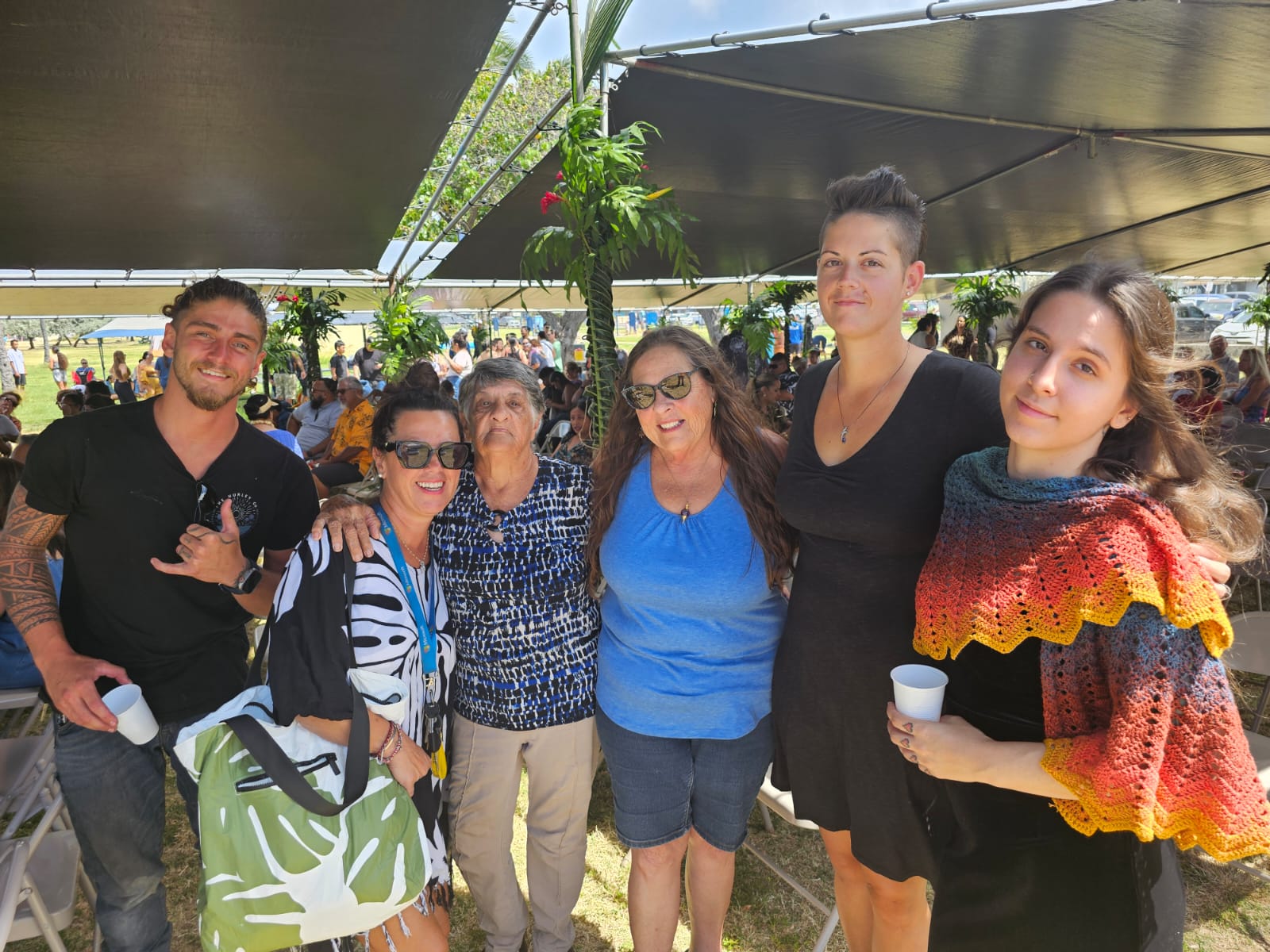
Community members gathered for Kai, at his families ceremony.
If they won’t use the name he chose for himself, I can understand why Kai would end up having to build his own ‘ohana. Is Kāhea, the name they use for him, a challenge to Kai’s identity? The identity he chose for himself. If Kai called himself Kai, why shouldn’t his family?
You hear it all the time. That the westside is about respect. A place defined by violence. One of the articles I had pulled up this morning, Dias I think, talked about how when “you’re born into Waianae, no one gives you an instruction manual (and while a lack of instruction may be true of other upbringings, the consequences are arguably more severe in Waianae)...You inherit a way-of-life that you take as a given: ‘That’s just the way things are. This is who I am.’"11
Maybe it's that Kai had tried to break through this mold of what his family, the world around him wanted him to be. And that they just couldn’t see what he was trying to do. Dias spoke of a culture of “must conform or I will die” and here we are.
Was it the same for Twinkle? For the ‘ohana she gathered around her, were they too trying to escape someone else’s definition for them? What would Twinkle think of Kai? In the articles I’ve read, Jessica Terrell said “She is worthy of many tributes, but to elevate her as somehow above or different from the community she served would be a disservice to her and her legacy. Twinkle was a remarkable woman and a remarkable leader, but a part of what made her so extraordinary was her ability to recognize the potential in everyone.To understand that people don’t have to have a house to be a part of a community. That homeless people can be leaders. That people in the throes of addiction, people who have made terrible mistakes and fallen from grace, still have something of value to contribute in this world.”6
I think Twinkle would have called Kai by the name he chose for himself.
I think she would have called him Kai.
Stepping out of the light
A crossing, a threshold
It's Tuesday again. Has it been days? Has it been weeks?
“If we’re going to do this, we should go. I have to go in tomorrow”.
Again? We were just in. What could matter now? The whole thing is collapsing. My mom. The emergency surgery. Then Kai.
Then Kai.
So we headed out the door. The same door. Not that long ago it had been Kai heading through this same door. I keep wondering if he would have turned left leaving our house or if he would have turned right.
Lahaina street is, probably, one of the most Hawaiian streets on the planet. I took it as the highest compliment when my old neighbor Nina told me “Oh, you da good kinna haole.” And maybe that's who we are. We’re the only white family on our section of a block, that frankly, the 90’s never forgot in terms of its musical stylings. Even Anthony, half Hawaiian, half Puerto Rican still bumps Counting Crows and Jewel when he’s painting cars under the pop-up canopy in his front yard. In some ways the westside is a place lost to time, but maybe that isn’t quite right. Old Hawaii is how I’ve heard it said. Dirt sidewalks. Chainlink and raw-block walls, maybe moss-rock if it's fancy. It's usually not fancy. Tumbling down half the time. Small lots and smaller houses.
A flash of light over our shoulders as we stand by the gate while I write this and then the audible pop of a mortar going off in the distance brings me back to here. I’m writing notes. I’m taking observations on a place.
If Kai was going to walk straight to Lahilahi when he made his decision he would turn left at the gate. We don’t know which way he went, but if he was going to go by Dustin’s, or maybe to walk across the sand at Aki’s one more time, he would turn right. No, that's not right. It's Kai’s beach now. Need to keep practicing.
We turn right and step out.
The west side of Oahu is what's left behind when you let colonialism run rampant across people for a couple hundred years. The smug trustafarians have Kakaʻako, not too far from Bowls, Kai’s old surf break. I think that's where he met Mike. We have Mākaha, Waiʻanae, Māʻili, Nānākuli. They can keep Kakaʻako.
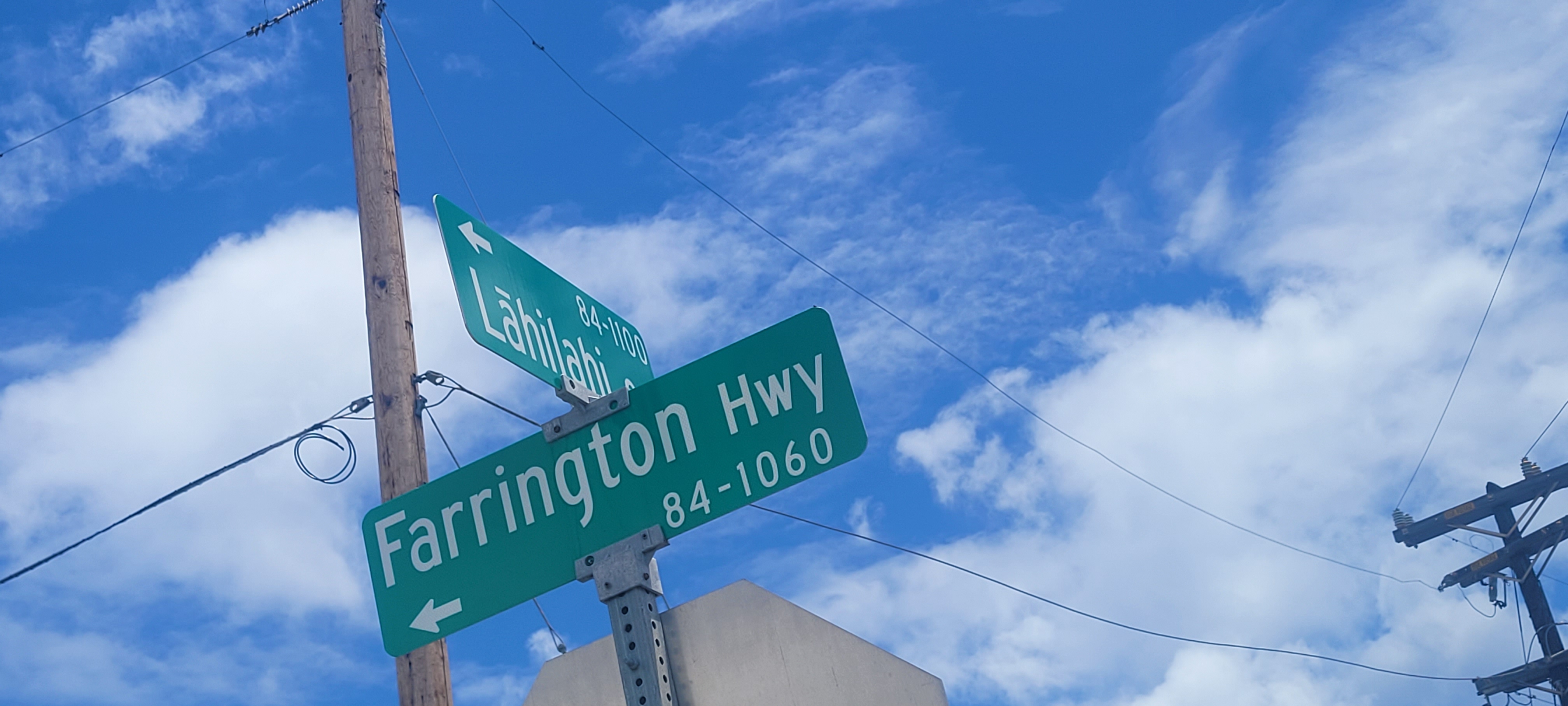
We turn the corner towards Farrington highway and on our left is a broken cover to some kind of underground utility box. The concrete is cracked and broken, and a mistaken step could easily result in a sprain or break. But then most of the kids here wouldn't even bother with slippers before getting on a moped or dirt bike. We’ve had five deaths on our little section of Farrington in as many years. Death is a constant presence here.
No wait. 6. I suppose it's 6 now.
The corner of Farrington and Lahilahi street.
We wind our way down through the streets that lead to Kai’s beach. The west side is a mix of linearly arranged streets, mauka to makai, but always more organic, more desire based. People on the west side go where they want, not where they are told.
Our feet have their own ends, and have taken us to Kai’s beach. It's cold. It's very cold. Colder than it has any right to be for Hawaiʻi, even at this time of year. The night we lost Kai, the first push of cold water from the north came in, and put a spell on the neighborhood. And the bay, Kai’s tiny little inlet, is unsettled. Intolerant. Until that day it still felt like we were in the days of summer. Easy lefts. Smooth, glassy waves. One to two-ooh maka-pu-hu (“you know da rules”). But on the night Kai passed, a swell moved in, and the ocean seems to reflect how the entire community is feeling. And the chill. This chill on the air has stuck around ever since.
We walk out onto the old coral shelf. It's just barely above the crash of the waves right now, with little streams and rivulets pouring backwards towards the land, and washing out again across the reef. Stepping out onto the shelf, we can see the huge overhead sets rolling into Mākaha. There is enough light coming from the homes to see the white wash. Waves are crashing and almost drown out our thoughts. It's cold. We turn to the south, to the rock, to Lahilahi. Even during the day, we would have to walk further out onto the reef to see the rock, and on a night like tonight, it would be flirting with disaster to do so. But we can feel it. We can sense the presence of Lahilahi in the distance.
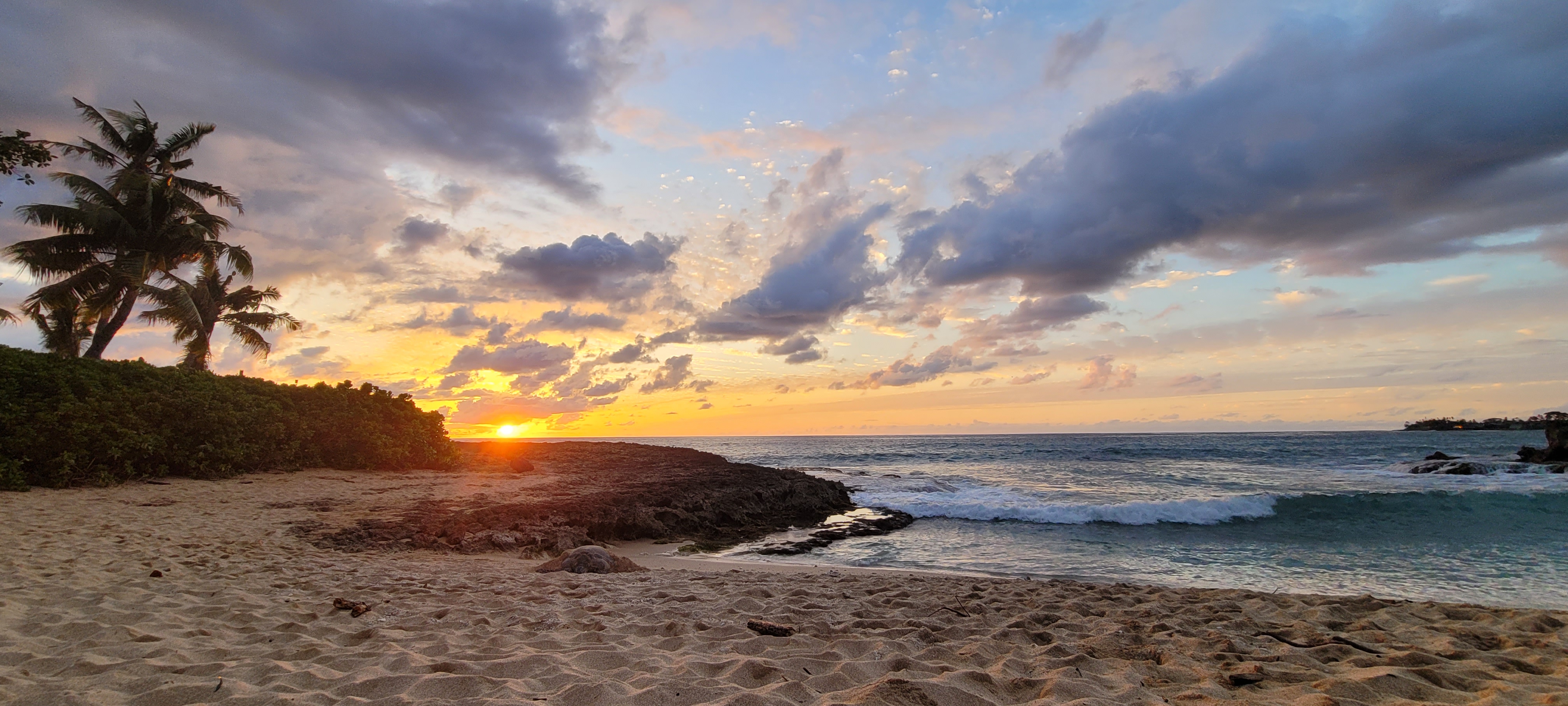
Sunset, at Kai's beach.
Walking back, we take the other alleyway from this tiny beach. Without speaking, we feel ourselves being pulled on this cold night. And as we walk, we find ourselves coming closer and closer to Lahilahi. To Kai’s last stop. Did Kai come this way? Did Kai make one last pass through his beach before his final steps up the rock?
As we walk, we come upon the entrance to Papaoneone. It's wedged between two condos, The Princess, and that other one. I don’t actually know which the Princess is. I don’t think Hayley knows either. Their parking lots are full, and bright, and burning against our eyes as we come from the low-lit backstreets we had been walking along. We push our way between the two buildings in the alley they’ve been forced to allow the public through to access the beach. Stepping out onto the beach, floodlights which run almost 24 hours a day, an artificial sunlight, probably chased away the turtles this place was known for years ago. In constant conflict, it seems, the old and new in this place. The new trying to pressure and push what's already here to go. The old, taking its time, and decaying what has become as it goes along its way. I look up the side of the condo. There is a deep crack running up the side of the building. Looking towards the south, we see only the sand, the condo, and the water where the light touches. Just past the edge of the light; nothing, total darkness. We’re blind beyond this line, this artificial edge. We walk towards it, and step past.
And there it is. So much larger than I’m used to seeing it, as soon as we step past where the flood lights reach, Lahilahi is suddenly upon us. A word comes to mind when I see it: grand. Grand, and grim in this deep cold spilling off the ocean, this built up darkness made even more sharp by the floodlights spilling themselves into the sea behind us.
It's a lot to take in. There was no preparation for this, for whatever we would feel when we got here. Hayley begins to cry. It's so cold. Why is it so cold?
Lahilahi, seen from the north, is a massive castle of basalt stone, erupting from the ocean. This entire side is covered in dragon fruit vines, visible even now in the dark of night. There is a rim of stone that rings the base, with a walking path around, mostly from locals and those who live on the rock. It's the end of the long chain of peaks that form the divide between Mākaha and Waiʻanae. Around the base, there are camps, like there are on most beaches on the west side. Pushed out of affordability from everywhere else, villages form in the only places they can. It was one of these camps that Kai… that he fell into that day.
And we stand there. Has it been 10 minutes? 15? An hour? No, not that long. But long enough it's getting late, and like she said, she has to work tomorrow. I turn to Hayley and we both turn to head back. As we walk back towards the light, Hayley jumps. And there is barking.
On our right, just above the sand in the grass, a dog is barking at us. And in a second, a man is apologizing to us from their seat in the grass. It's his camp and he’s sleeping with his dogs just above where the waves will come. Two dogs? Maybe three? And a hoopty single speed bicycle. The man comes out to apologize, and I greet him with the open palm Kai would have used. He asks if we are staying at the condos and I say no we stay further up Mākaha. And quickly it all comes spilling out of me, Kai’s passing, and our walk to see his last place. And suddenly he understands. He asks us to sit down and he begins to talk, almost as if he knew we were coming.
He tells us about the rock, Lahilahi. How this is one of the most special places to perish, that there are only a few other places in the world as special as this one to have passed. We ask him how long he has stayed here and he says many years, but that he’s not ready to make his way onto the rock yet. He says that once you go to the rock, that the rock takes you in, that it protects you. But that once you go to stay on the rock, that it expects you to stay, it's part of the deal. A transaction between whoever comes to stay there and the spirit of the rock. We hold hands and form a circle. He says a prayer, to guide Kai’s spirit. We break hands and we say thank you to the man. We begin walking home. We say nothing. It's cold. It's so cold.
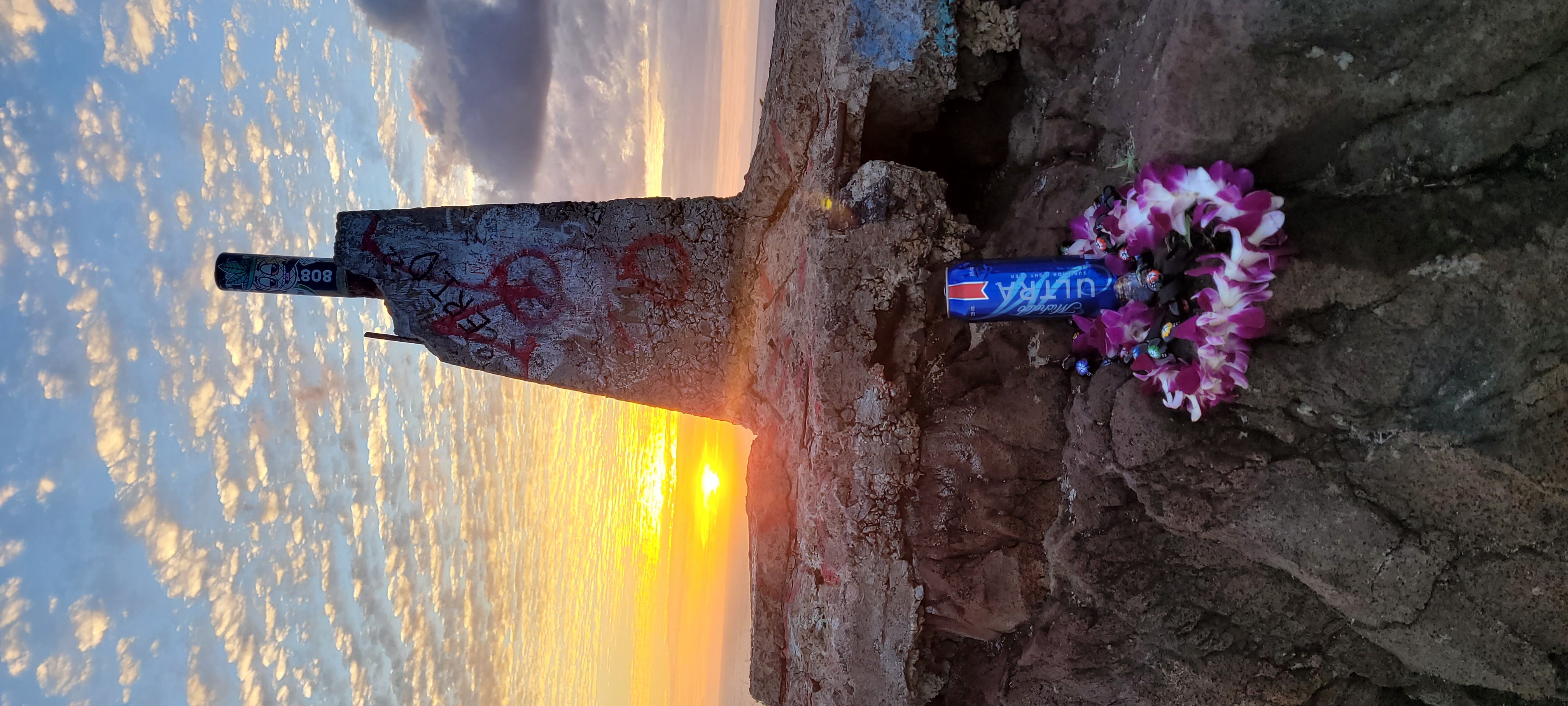
Sunset, from the top of Lahilahi, with a small offering for Kai.
Paddle out
It's Saturday. It's been a week since it happened. Since Kai not coming home. What happened? How did we get here?
There is a job to be done today. I begin packing the truck. Chairs. Canopy. Shovel. Things. A bag of things we all picked out together at Waianae store. I’m in the truck. I’m pulling around the Aki’s, no, Kai’s beach.
We got worried when Kai didn’t come home Friday night. It wasn’t totally out of the norm for Kai to stay with Adam some night, if they had been partying. And on a week like that week, where Kai didn’t sleep. Neither of us were sleeping that week. But I tried calling Adam that day. I didn’t get a hold of him.
I pull around the corner of Upena to the little alleyway that leads to the 80 foot spit of sand we all call home. It was named after the Akis’, who own the house right at its center. I don’t think they’ve lived here in decades. I start carrying loads down to the sand. It's still early enough that the sky has that glow that comes only for sunrise. Dustin catches me walking down the path carrying a folding table. He helps me with the rest of the gear. Together, we start digging.
Last Sunday, sitting at Skinny Adam’s, that was when we were able to put the entire timeline together. That week had been bad for Kai. He hadn’t slept since Sunday. His insomnia was worse than mine. But Sunday, I know he didn’t sleep Sunday. Monday he went to work, but after not sleeping Tuesday, he called out. This was typical for Kai. If he missed more than 2 nights of sleep, he wouldn't go to work.
“Like this brudda?” Dustin asks me. “More round, like a circle Dust’, and bigger”. I begin collecting stones off the sand and out of the shorebreak.
As a house we tried to be respectful of giving each other space. Not to be too nosy. Bel, back living with us as housekeeper, returned after taking a swipe at town life. She was good to Kai. Bel made sure he ate. They were buddies. Nights of dabs and streaming their Uno games on the porch. But not that Friday. We just thought he was cruizin’ with Big Adam.
Dustin keeps shoveling sand and the mound is getting bigger. Ariel, Dustin's daughter, is helping place stones around its base as I’m going back and forth carrying armloads more.
We started to really worry on Saturday afternoon. I kept expecting Kai to show up. Saturday Bel and I drove around the neighborhoods. No sign of Kai. Sunday morning, 6AM, and Hayley and I start to drive the west side. Now we know something is up, and frankly, we didn’t know what to expect.
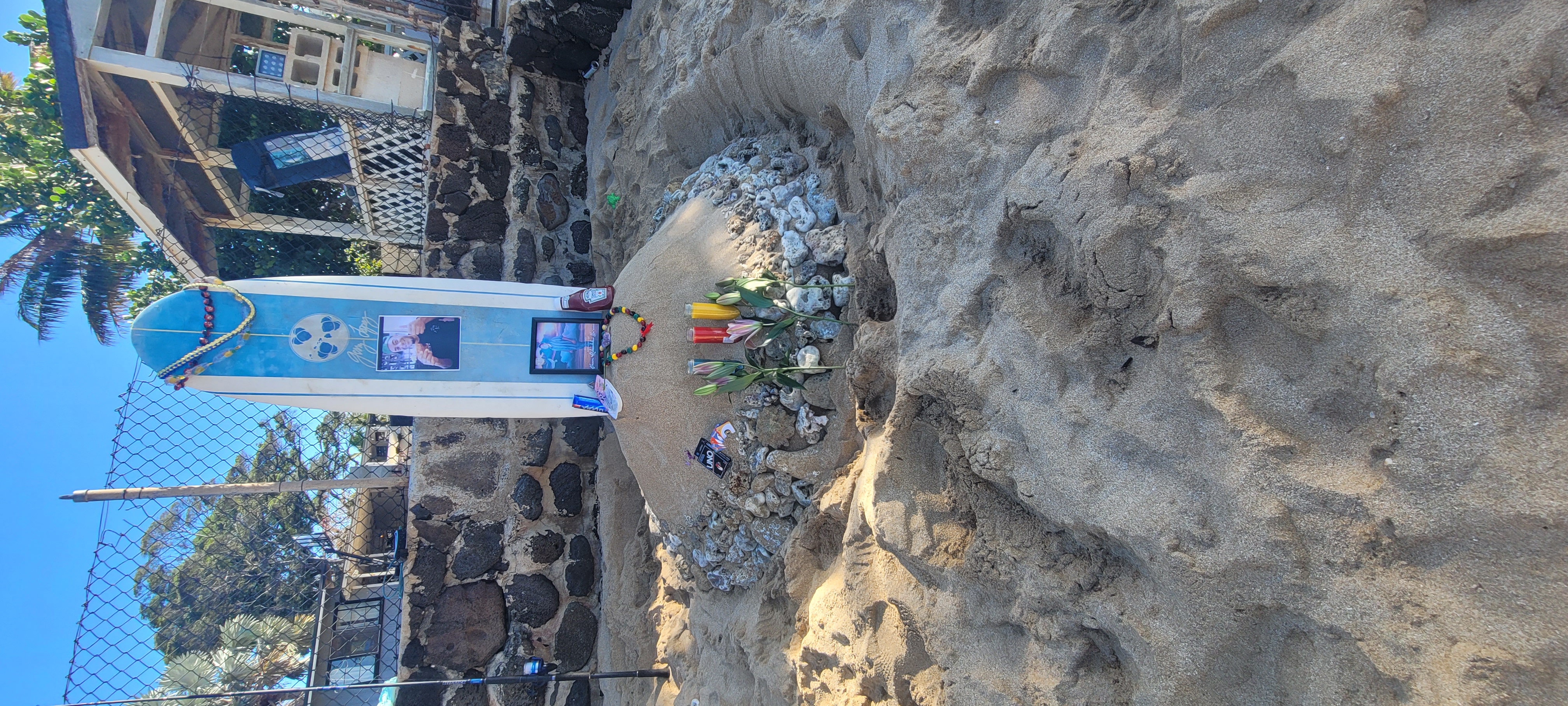
“Think it's time for his board?” Dustin says. “Yeah I think so. Let's plant it deep. Big waves today,” I responded.
Nānākuli, Māʻili, Waiʻanae, Mākaha, Kaʻena. There was a lot of west side to cover. We started in the most obvious spots. The neighborhood. Mike’s old house. First we drove around the neighborhoods. Then we drove to Nānākuli and doubled back towards Mākaha. Paying attention at every camp and slow rolling past, looking for new additions. Maybe Kai had gone back to being chronic.
Dustin is finishing piling up the base around the board. Ariel is working with him to place stones, all white ones. Coral. I’ve gathered everything I can find on the sand and begin to gather stones from the shorebreak. Ariel helps by taking rocks up to her father.
We focused on Māʻili for a while. It's where I had thought we would find him. His brother, I think his brother lived Māʻili. And well, I half expected Kai to be manic in an alleyway nearby. A man like Kai, who never spoke bad about anyone. Kai hated his brother. We left Māʻili with only one place left to look.
Dustin and I have finished the base. We start setting up tables and canopies. Skinny Adam arrives. He brought down his board for the paddle out. But the ocean. It's unsettled, roiled, boiling over. It's a big day today.
Leaving Māʻili, Hayley and I started the drive to the only place we had left to look: Ka’ena point. Ka’ena point is at the end of an eight mile stretch of highway that, when leaving Mākaha, is only populated by a few small camps and villages. Our Lady of Kaeʻau and Ranches. Pray for Sex. Mākua. And then the point.
Skinny Adam and I are setting out the food he brought down onto tables. Dustin has returned to his place to get the grill started. Some neighborhood boys have come down and look like they are going to do some bodyboarding. The waves are coming from all sides, turning the little bay into a whirlpool. Just not a day for going out.
Kaʻena point. One of the first places on the westside I learned about. Carmen, an aunty who rented a room from me a few years ago. She said it was the place where the souls would leave—a spiritual exit—pointing between the last islands in the archipelago. Hayley and I read about it in our book of legends. Kaʻena Point is known as a leina a ka ʻuhane—a place where souls leap into the afterlife.12
More neighbors are arriving. Bringing chairs and setting up. Mike brings out a picture, and I ask one of the neighbors, Erin, if she has any push pins. Skinny Adam is watching the beach. But it's too big to go in. We’re not sure we’ll be able to paddle out.
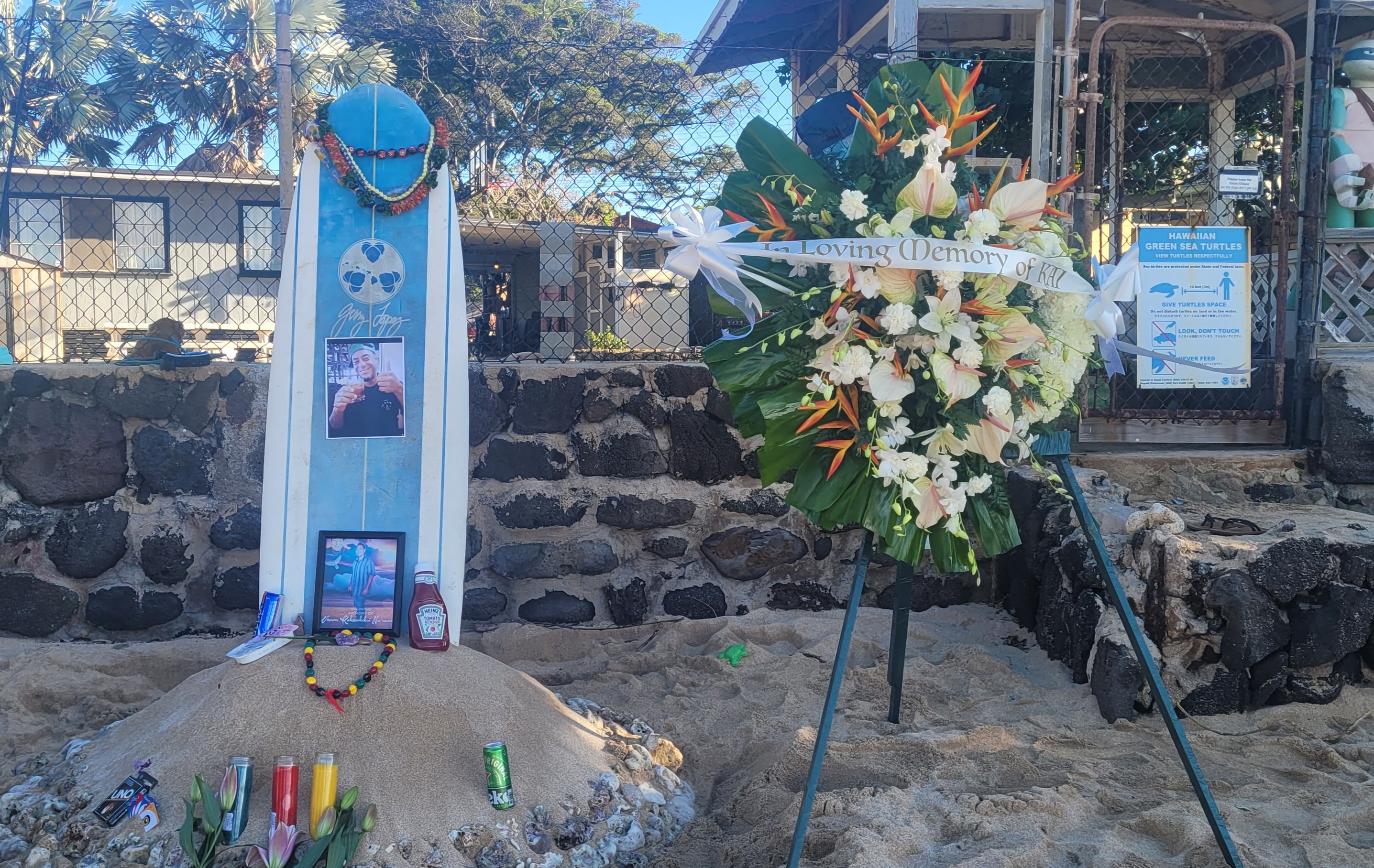
The start of our community shrine dedicated to Kai.
The book of Hawaiian legends I got at the sugar mill, it talks about Kaopulupulu. In the late eighteenth century, Kaopulupulu, the kahuna of Waimea, serves King Kahahana with his son Kahulupue, but he sees the king sliding into tyranny and says so. Kahahana ignores the warning. In quiet revolt Kaopulupulu tattoos his knees, a public sign that the king has lost his right. Furious, Kahahana orders father and son seized. Kahulupue urges flight to Kauaʻi, but the priest, already certain of their fate, refuses. They walk west from Waimea, pass Kaʻena Point, and there Kaopulupulu tells his son: “Be strong of breath, my son, till the body touch the water, for the land indeed is the sea’s.”12 And just so, this place became an altar to a death presupposed. Hayley and I round the corner towards the point, driving slowly.
The boys who brought down bodyboards look like they are trying to get some. Good luck kids. If they stay to the left they’ll be fine. They’ve got fins. Kids here know whassup.
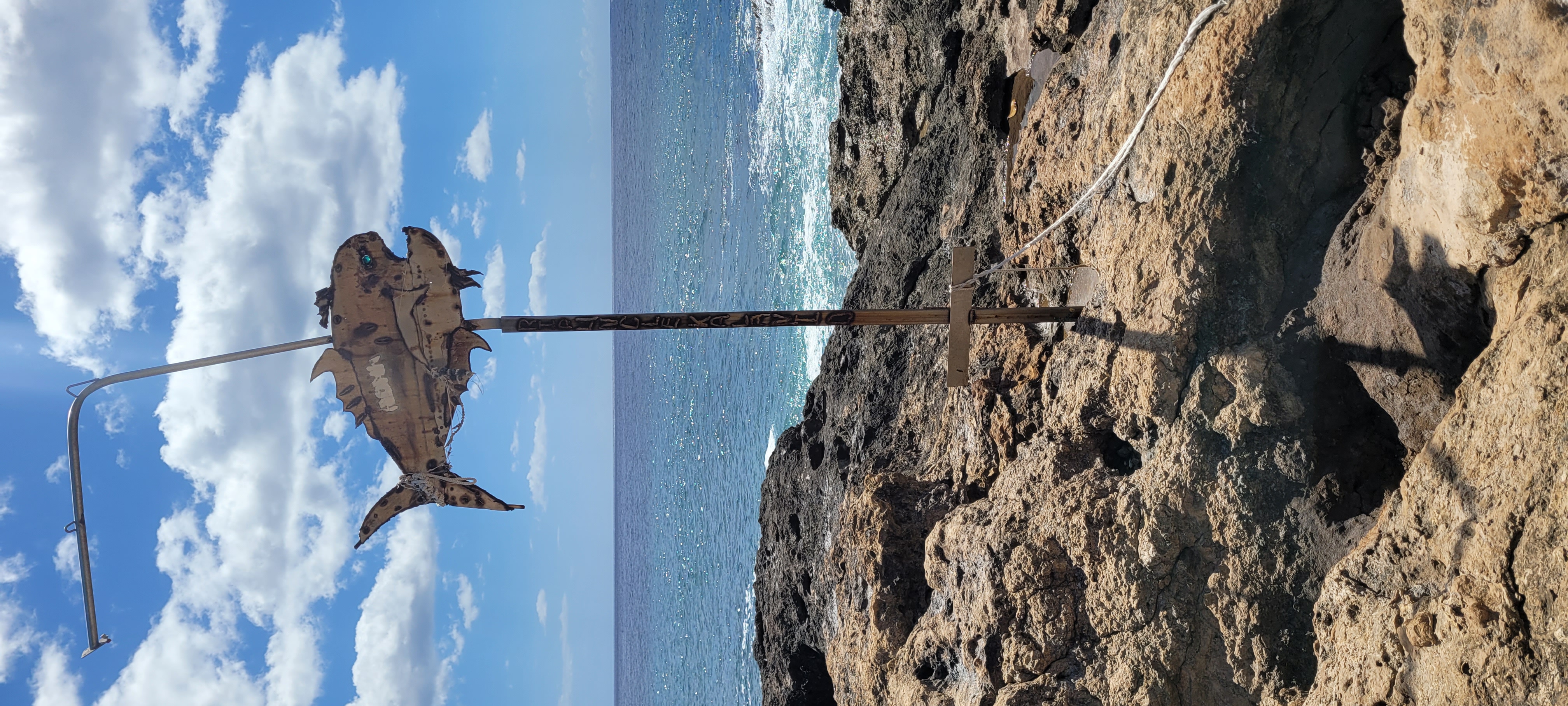
A shrine dedicated to "Uncle".
We pulled up to Keaʻau beach park. Out on the rocks, a metal fish at the end of a square rod was sticking out. A memorial, a shrine. “Uncle” welded onto a metal pole, an angler fish at its end. A fishing pole was left on the rocks nearby. We walked towards the camps. We found a marker bolted onto the rocks. As we walked, more memorials became apparent. Lei, plastic flowers, kids toys. A bottle of beer. A picture of a loved one. Grill grates protecting something that was the most important thing to someone, for a while. Four? No five memorials. Why am I counting? Where is Kai? We get to the end of the park. Same tents in the same spots. Kai’s not there.
I have a bag. I’ve got some ketchup. Some Michelob Ultra. Candles, an Uno deck. I place the large bowl candle at the top of the altar. I place the three candles in the Kānaka maoli colors at the base. I arrange an Uno hand and place it under a stone. I place a lei over the top of the surfboard. I place another at its base. I open the can of ‘lobe and it goes on the left. I put the ketchup on the right.
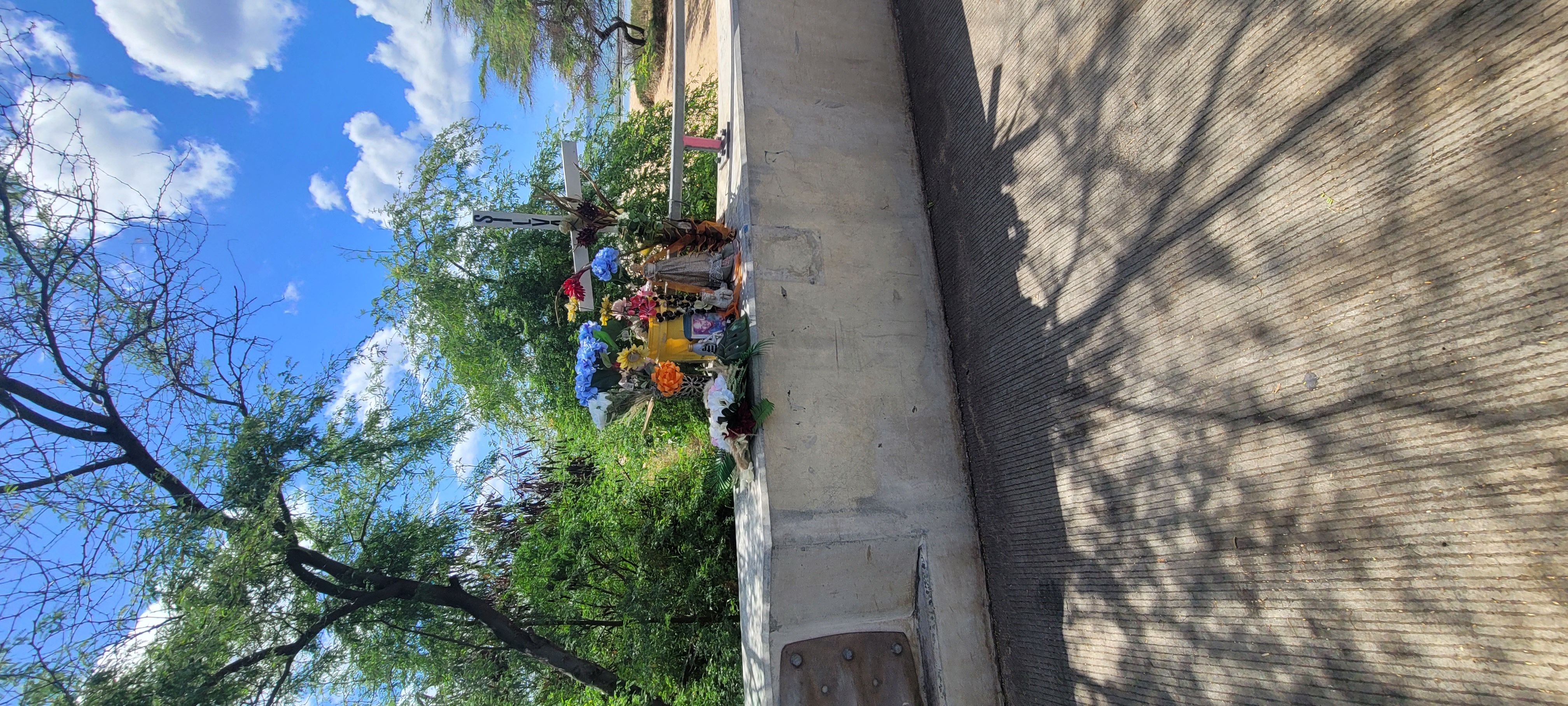
We slow-rolled past the camp at Our Lady of Keaʻau. Nosy, who gives a shit. We’re looking for our best friend and haven’t found him anywhere. Two shrines oppose the highway here, one, “Silva”, a cross strung with lei, plastic flowers. A fresh torch ginger. Two older, dried out. Across the highway, another shrine. For a child. I know this one. Our neighborhood auntie, Miss Carol, knows her. The child died at the pool at Our Lady of Keaʻau. There is paint behind the offerings. Kids toys. An owl. A book. Lei. Plastic flowers. Some newer, still holding their color. Some faded. Sometimes it's just the regulars, some days its people setting up at this beach. That day, it's just the people who call it home. We found no sign of Kai.
A shrine dedicated to "Silva".
Neighbors begin to bring more offerings to Kai. A can of corned beef. Heineken. A sticker. Tulips. More lei. They are all placed onto the offering carefully. The air is cold and the wind is blowing hard today. Skinny Adam is still watching the waves. Where are those boys?
Hayley and I arrived at Ranches. A bigger and more established village than the one across from Keaʻau. There was a car pulled up where the hose that comes up from some spigot the ranch leaves out for the village. No one was in the car. The camp was quiet. No one was out. Down a bit further, makai side of the highway. We found another shrine. Two names. Concrete bowls of food. A balloon. A can of beer. Water. Lei. Offering whatever they might want or need. If Kai was out there, we needed to keep moving.
Skinny Adam sees it first, then me. One of the boys is out of the water and up on the cliff on the right. What is he doing on the right? You shouldn’t go on the right at this break. The left looks scary, but the right is the real danger. And on a day like today, if you get stuck in that current…
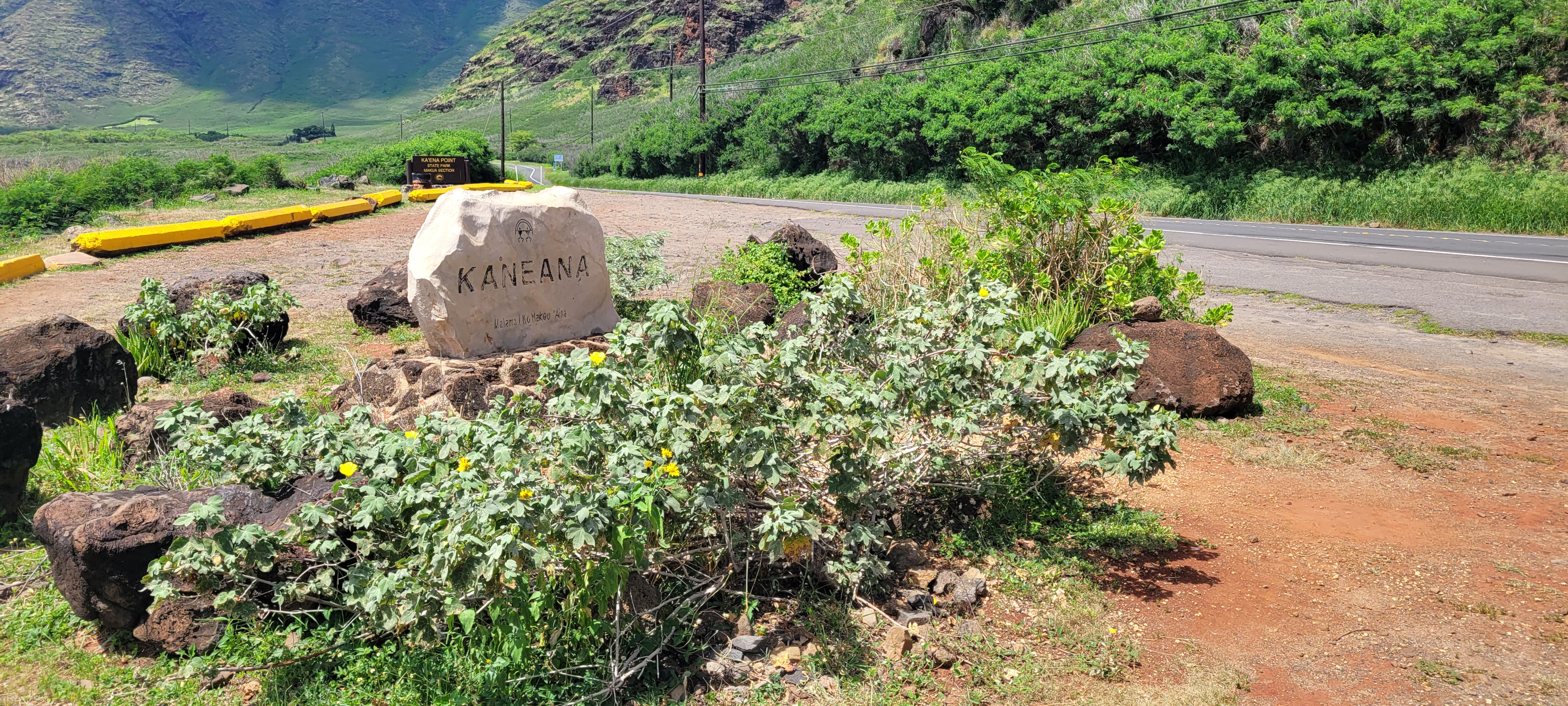
Hayley and I arrived at the cave. This is where Kaʻena Point State Park begins. Hayley asked what we’re stopping for. Let’s just look around I said. The place marker. Its plaque was gone. A stone sits on a concrete pad. Faded, worn markings streak its sides. I looked up the cliff. No sign of any one. No one was out that morning. Plants surrounded the place marker for the point. We got back in the car and kept driving.
A stone marks the beginning of Kaʻena point.
Suddenly, Adam is grabbing his board. The kid, the other bodyboarder, he’s going under. Over on the right. He’s calling out for help. I run over to the cliff where the first boy is. I take his board and his one fin and I throw them on and follow behind Adam.
Mākua, and there was a bundle of lei on a kiawe tree. No names, no markers, but someone had been adding to this. The sun and wind have done their work, but more lei keep being added. A reminder that it's us versus time. We keep going.
I find myself in the water. This is a day you would be fighting to survive just on your own. Now I’m doing a rough water rescue, and I haven’t even warmed up. Adam reaches the first boy, but now Adam is struggling. Sometimes we’ve needed 5, 6 people to do a rescue. But today, it's just me and Adam. I grab the boy and throw him onto Adam's board. He hasn't taken in water. I tell Adam to just hold onto his board and keep the kid on. I flip onto my back and begin paddling back to the shore, pulling the board and keeping an eye on Adam and the kid.
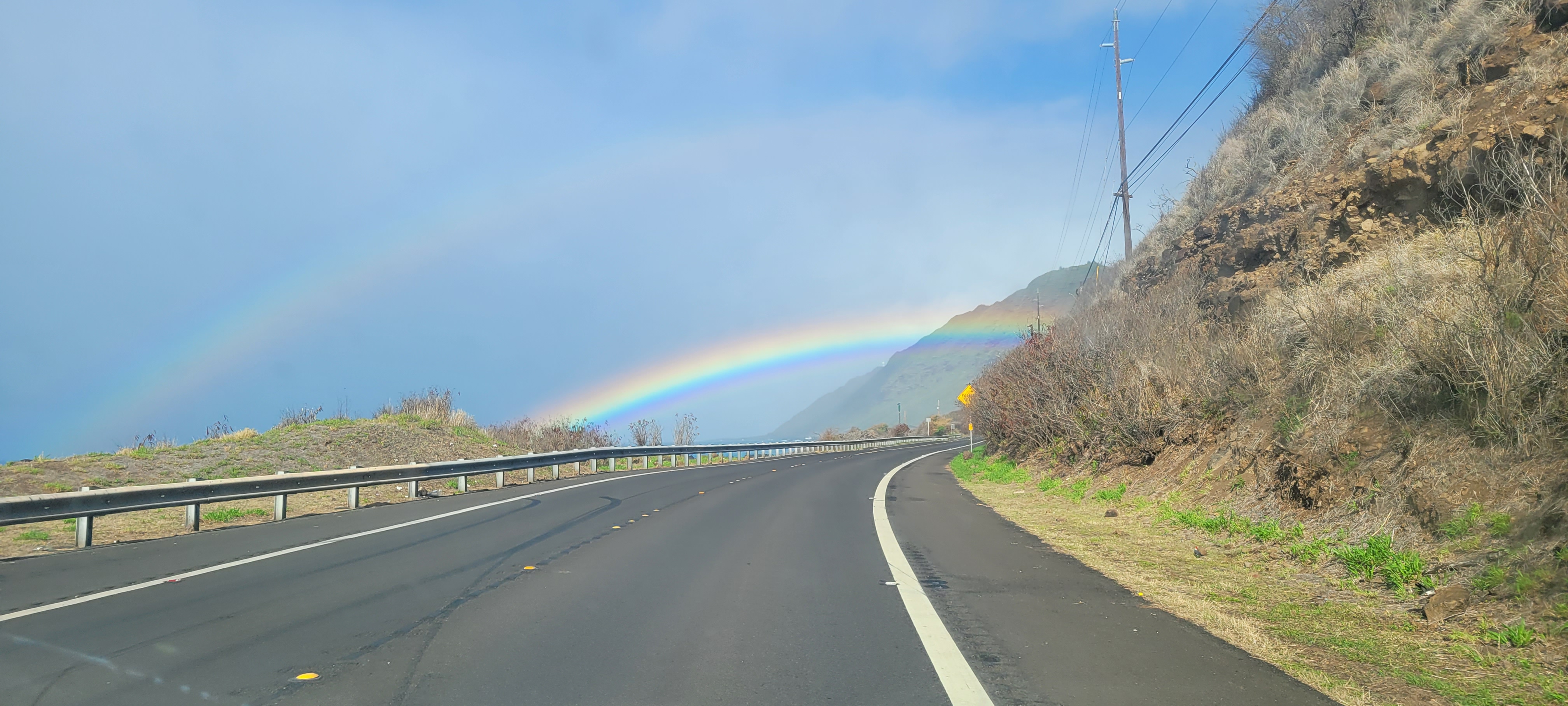
We make our final turn into Kaʻena point. Just at the moment the point becomes visible, a rainbow appears before us.
The rainbow which appeared to us while we searchd for Kai.
No. God no. Kai.
Kai was dead. At that moment we both knew it. Kai had died. We could feel him. One of the brightest rainbows we had ever seen. It wasn’t off in the distance. It was right here. It was right there with us. He was saying goodbye. Kai was saying goodbye to us and there was nothing we could do about it.
We both began to cry. We had found him. There was nothing left to look for. We pulled into the turn out above the parking lot. We turned around. We drove back.
Adam and I pull the kid onto shore. I’m fucking dying. My calves are cramping. Adam is choking out. The kid is coughing. Coughing but breathing. What the fuck just happened? We’re all on the sand wheezing. I’m rolling in the sand like a seal with one fin on.
Hayley and I pulled into the police station. As we pulled into a parking spot, my cell phone rang. It was a call from Bri. “He's dead.” I opened the door to the car and vomited in the parking lot. We drove to Adam and Bri’s.
Adam and I are like “what the fuck just happened.” I tell the kid to maybe wait for an easier day before going out again. God the water is cold. I know it’s winter but how the fuck is it this cold. Adam and I are gassed. Probably we won’t be paddling out today.
After the call with Bri, the community began to assemble on her and Adam’s lanai. Dustin, Laura, Mike, Bruce. Ethan and the baby. The neighborhood keiki are told to go play. We begin to piece together what we thought had happened.
Laura had seen a commotion at the base of Lahilahi Friday when she was at Longs. Bruce had worked the shift at the ER at the comp, and knew a John Doe had been brought in, which was weird because they don’t normally do that at the comp. Dustin, who Kai had reached out to on Friday. Kai was being super evasive. Not being clear about what he was going to do.
Kai’s family arrives at Aki’s. Somehow I’m still wet and covered in sand. Kalei, Kai’s sister, introduces us. “We wouldʻve come earlier but we had a regatta this morning.” They’ve come in force. The only members of his family I recognize are his sister and her husband, and his daughter, Honu.
Offerings at our community shrine grow.
I called the medical examiner. “No, I’m not in the family. Well not that kinda family, but I’m his friend.” Confirmed. Vernon Kāheaokekeai Naʻauao. Kai. Kāhea. Vernon. Found Friday, January 10th, at the base of Lahilahi.
More offerings are placed at the base of Kai’s board. A big female honu comes up, just below where we had placed Kai’s board.
The sun is beginning to head to the edge of the ocean. We begin to circle up. Ethan, who practically grew up at this beach, says he’ll paddle out. It's too big today for everyone. Adam and I sure aren’t doing another rescue. Speeches are made. We join hands in a circle. Ethan offers what we can, back to the waves. We ask that the neighborhood, that we now call this Kai’s beach.
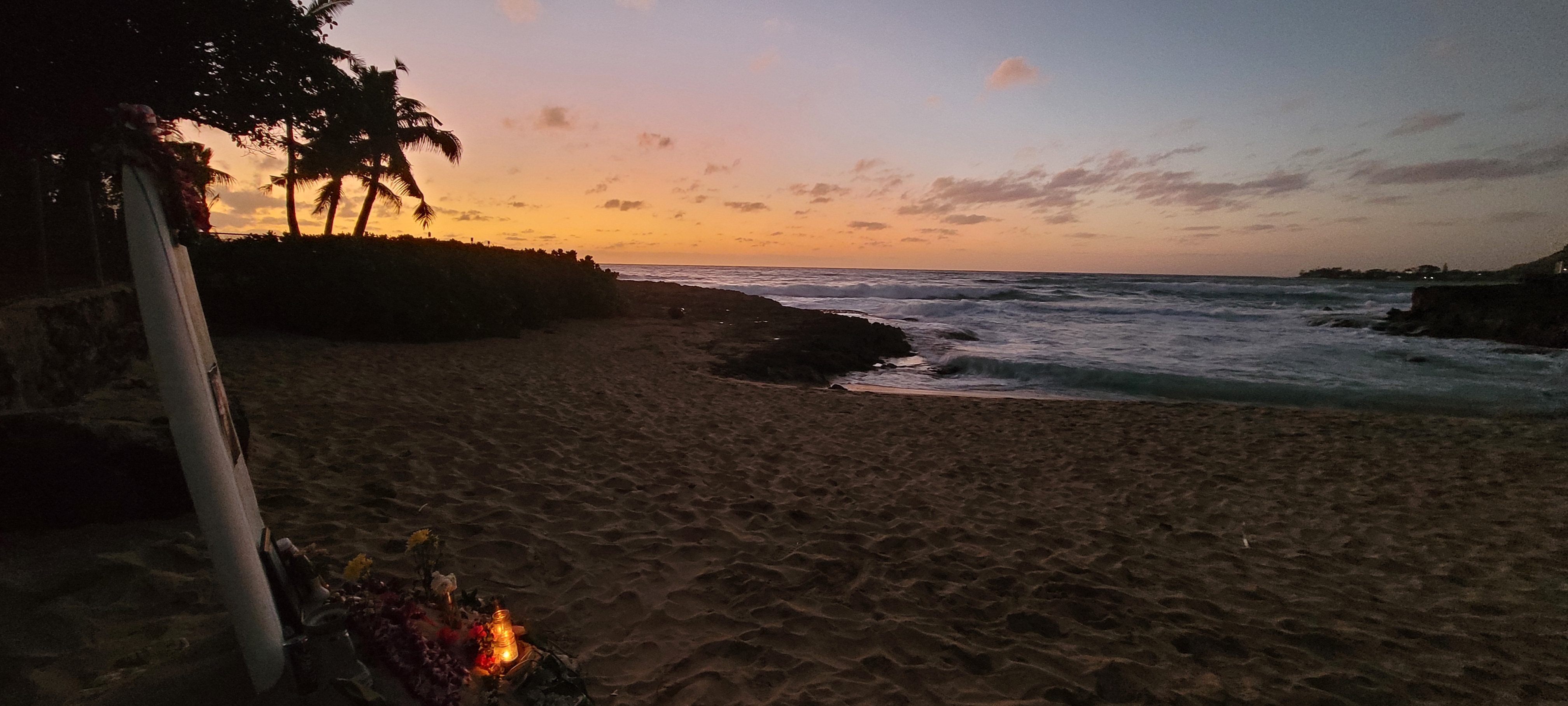
We light the candles on Kai’s altar. It's clear out, but colder than I can ever remember it being. The neighborhood stays after the family takes their leave. We hold our place there, on that strip of sand. We drink Michelob in Kai’s memory. It's so cold. The ocean is throwing itself onto shore.
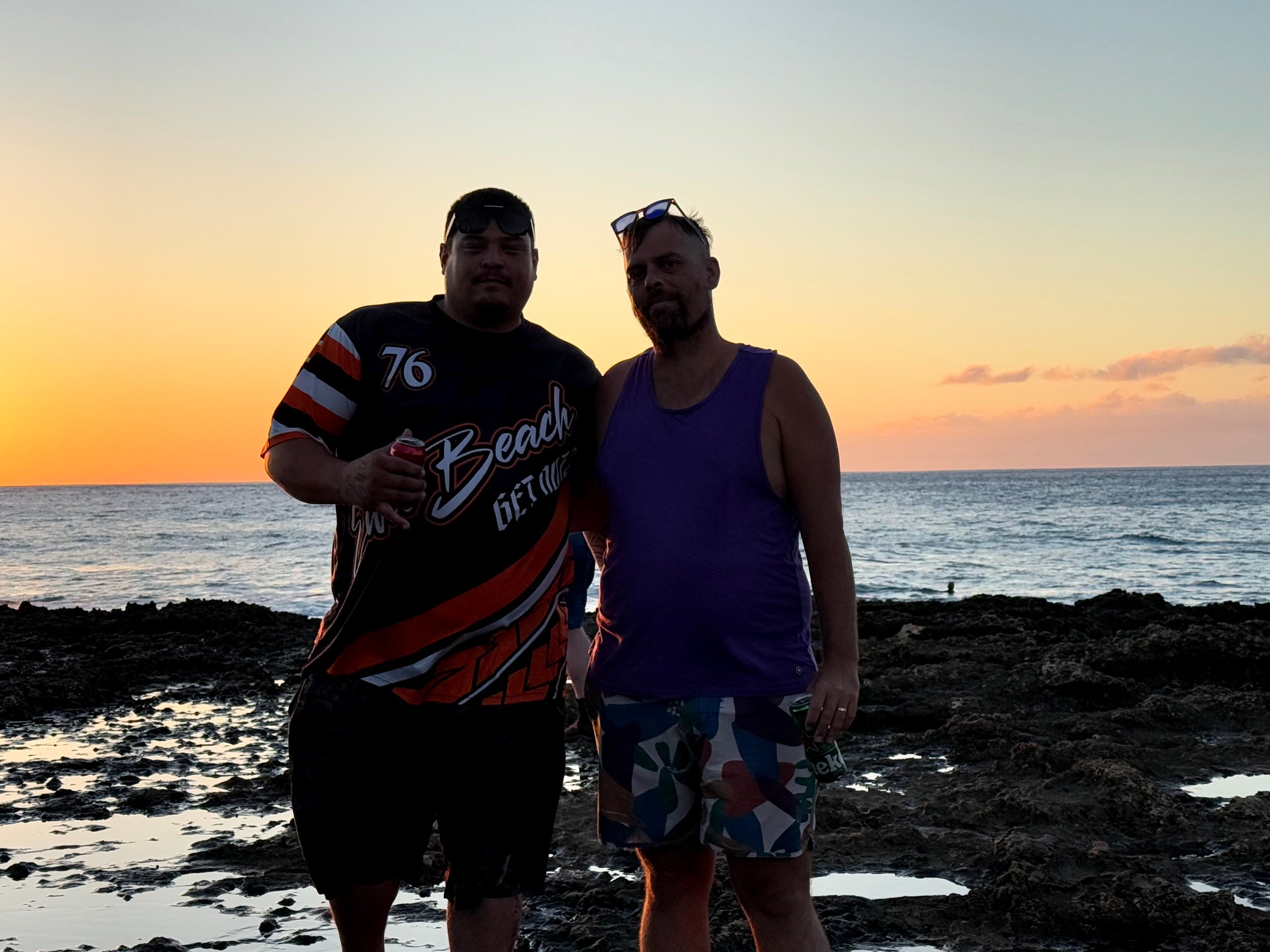
The sunset, looking out from Kai's beach.
We would keep the vigil going at that spot all the next week. And the week after. But eventually the waves came up and took the lei and got the candles wet. The big honu would stay at Kai's board the whole week. And everything changes, at least that's what they say.
You're gonna carry that weight
brooo
when you getting married
May 10th, Ewa beach park.
Starts at 3pm
just making sure we’re good to come Saturday and all. Can we bring anything? Help set up?
Of course you guys good to come bro. No need help setting up but I know she’s stressing about having enough food
can I help by bringing more food?
I can make pizza
Yes please anything would help
send me ur cashapp
Broo..
Think of it as from Kai and me. It's the last rent Kai gave me. It's just been sitting in my cashapp since he left.
Thank you for real bro we appreciate you guys
Ceremony starts at 3pm we’ll be there around 10…
for real. Love you bro
Love you too bro
“The wedding is in two days and you still don’t know when it starts?” Hayley sings as I text Big Adam.
“Its fine. Ewa beach,” which is about the extent of what I know.
“There's a lot of beach in Ewa beach” she responds.
Yeah we’re invited, it’s 3-5:30 Ewa Beach Park. Saturday May 10th. Red and Black are the colors.
It's Friday, the end of finals week. I’m making pizza dough. I’m cutting and roasting eggplant. I’m harvesting basil from the yard. I’m making meatballs because I only have 5 lbs of pork and this will make it go further. I’m thinking about whether I need to go to Waianae store and refill the propane. I’m not thinking about the project. I shouldn’t be adding more to this, this failed attempt at gonzo. I wasn’t brave to do it like Thompson. To jump all the way in. Like Kai would have. But these are my best friends, and I’ll love them to the very very end. I’ll do it the only way I know how. With the love Kai gave me to carry forwards.
Big Adam told me that it was after Kai passed, that was when he and Kawehi came closer. Kai spent almost as much time on Adam's porch as Adam did on mine. And since then, Adam asked Kawehi to marry him.
Theo in his spot next to Kai, by the window.
It should be Kai helping Big Adam get ready for tomorrow. But on the island of misfit toys, who will carry the weight of the dead? I bring our basket, the one we keep Kai in, into the kitchen to hang out with me so we can work on Adam’s wedding feast together.
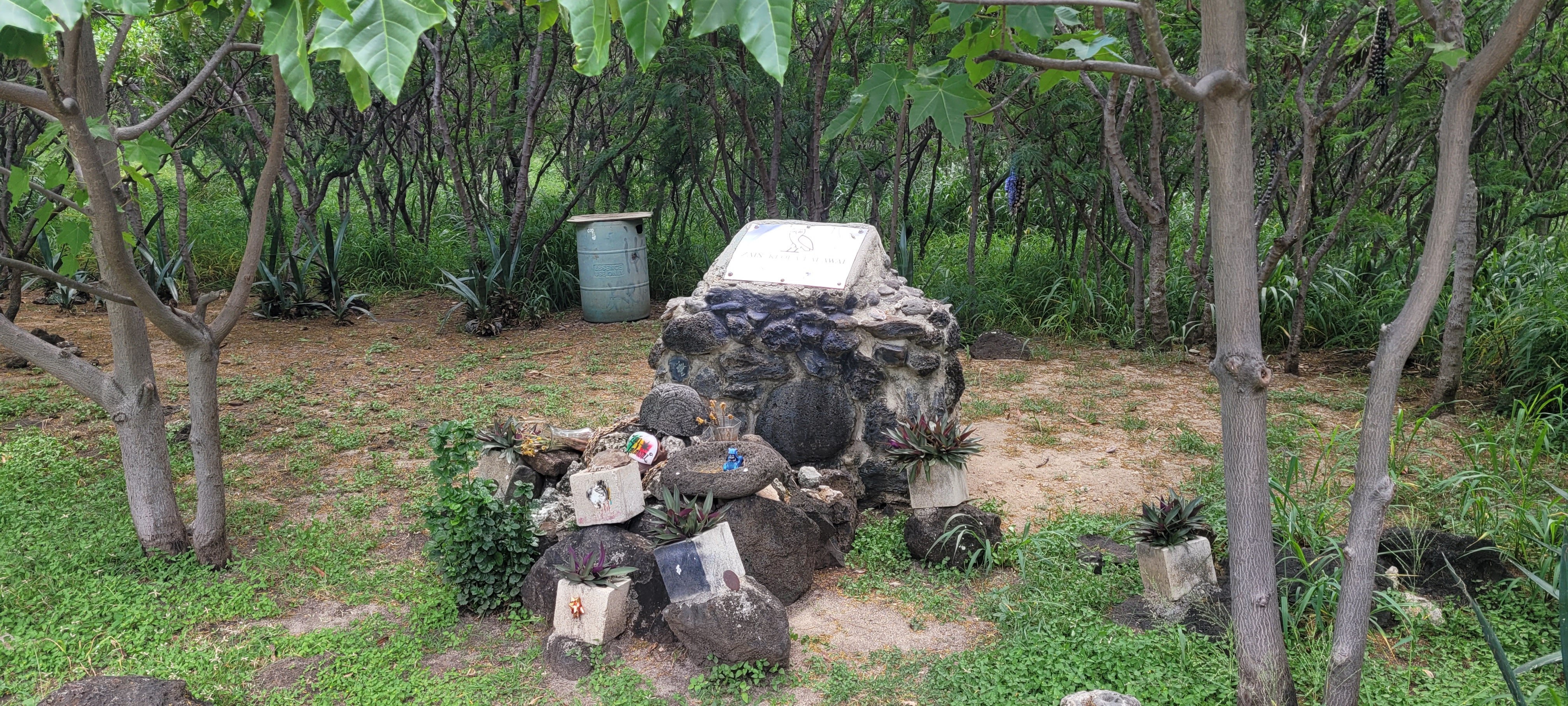
Over the course of the past month Hayley and I have visited and documented most of the shrines from Mākaha to Kaʻena point. Before Kai passed, we knew of five. At the time of writing we’ve found more than thirty. The more you look, the more you see.
An ancient shrine, yet still cared for.
Kaumaha—the holding of the heavy weight of grief and sorrow. The physical weight of it.
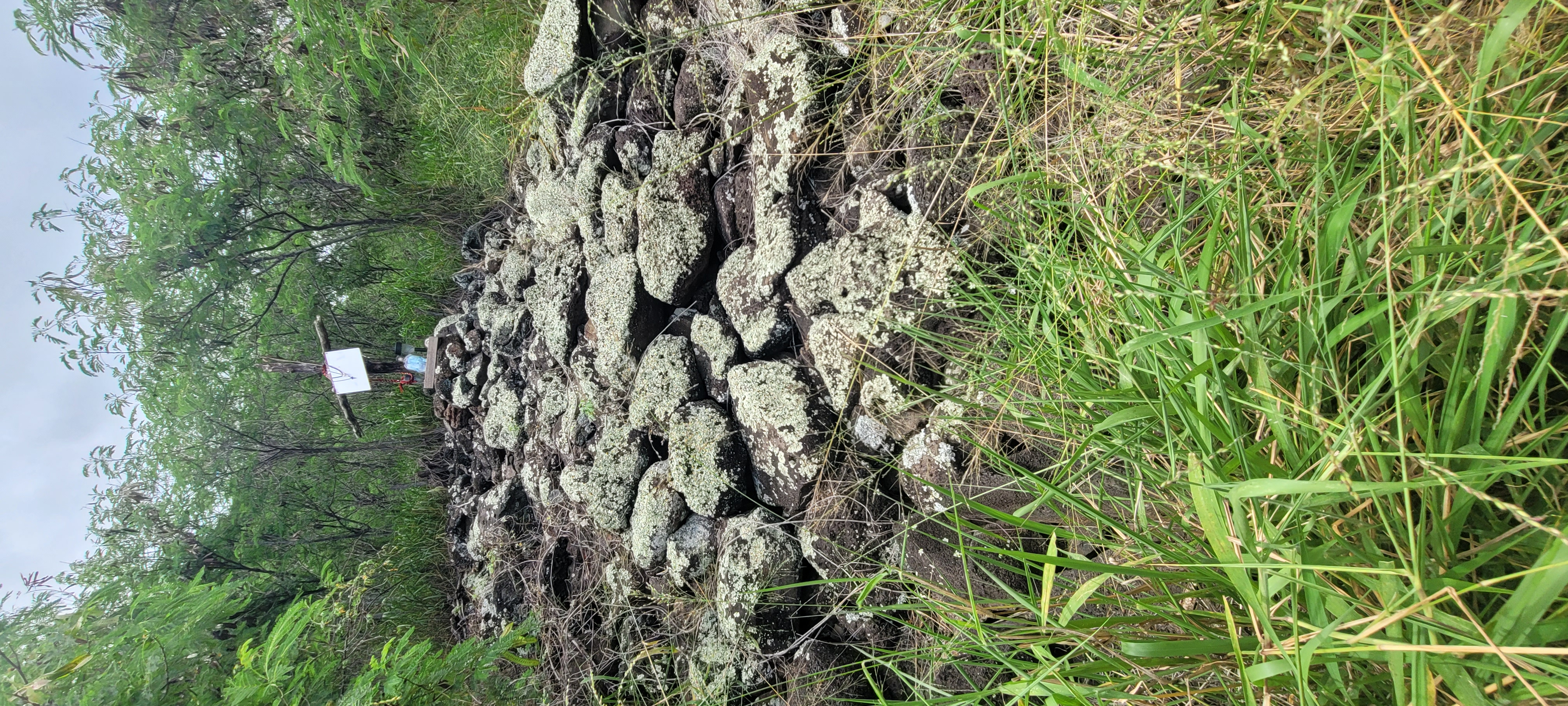
Some of the shrines are old. There is one in particular, up-valley Mākaha, that based on the amount of lichen covering the rocks at its base; It's old. I can’t say for certain how old, but many, many years. More than decades.
Some shrine are young. Since Kai passed I know of two more that have come up on the west side. One for “China”, also at Lahilahi. Another, just a pole in the Mākaha beach parking lot, now decorated with lei.
Some of these shrine, surely, are cared for by family. But many are refreshed by friends, the ‘ohana of one's own choosing. We would like the dead to know they aren’t alone.
Almost all of the shrine we’ve found are on the makai side of the highway. Some are no more than a few stones. Most have lei. Some have kids toys. Some beer. The most visited ones sometimes have torch ginger, a special deeply red flower that seems to survive the heat better. About half have a plaque or had a plaque. Some are just a plaque.
The protestant cemetary at Mākua.
Some seem to have been forgotten or lost. Most, though, are regularly visited. Even the plastic lei flower break down in the westside sun. And so you can see that some have had many many returns. Others not as much, maybe once per year.
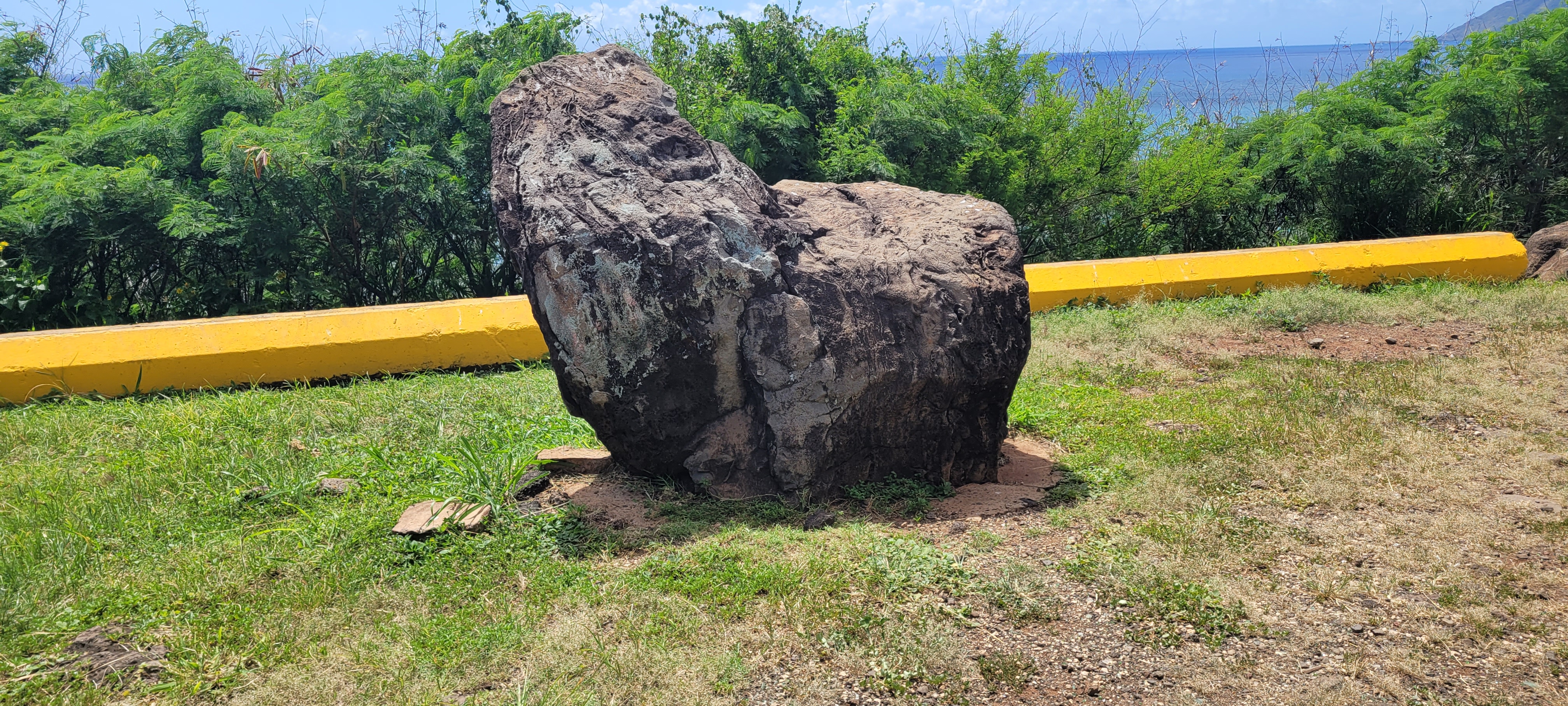
An informal shrine just outside the cemetary, where stones have been piled to create easier access.
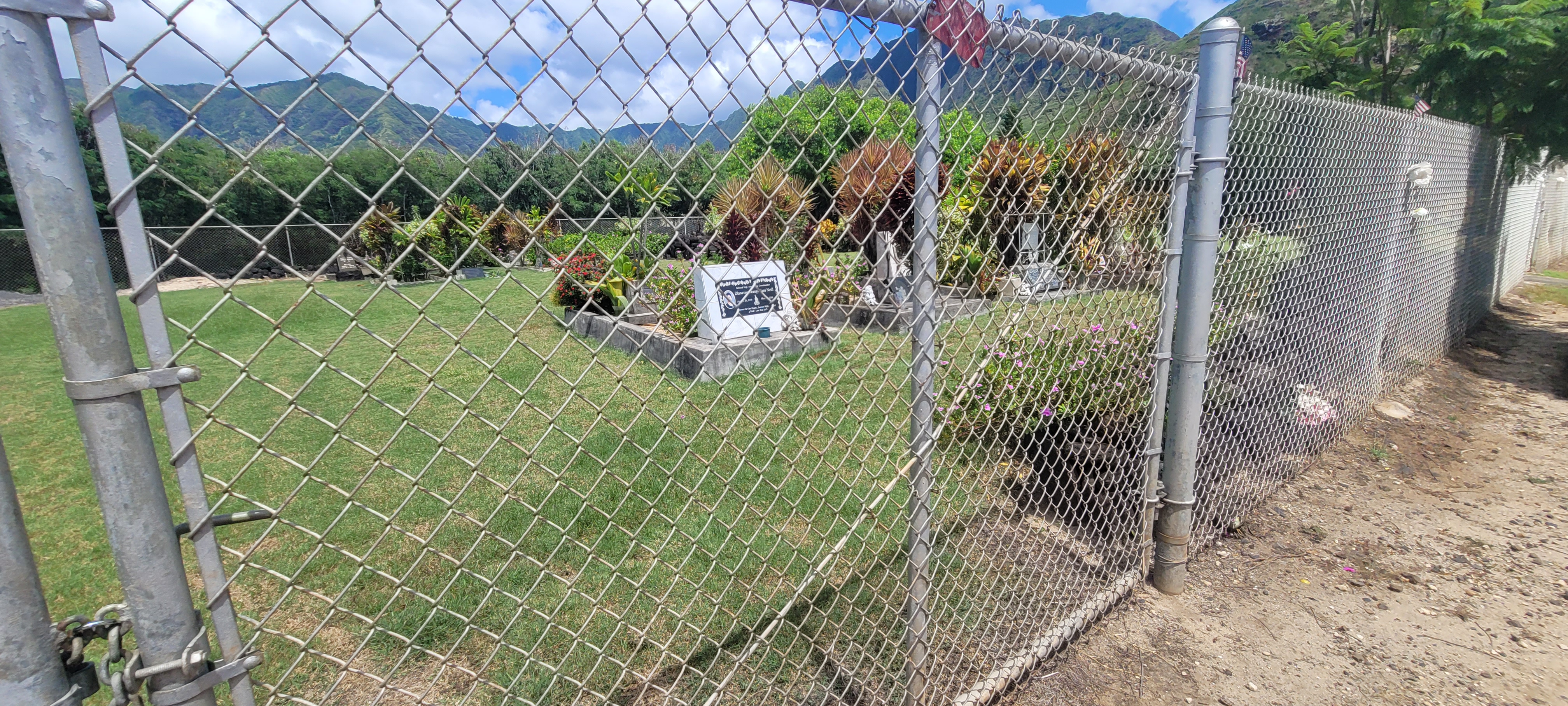
I count among them the cemetery at Mākua. But it's not like the others. Firstly, it's behind a wall of chain link, with locked gates. The graves there are, well, graves—whereas I don’t know how many, if any, of the other shrines inter remains. These graves have many of the same elements. Lei, ti-leaves and plants, stones of importance. But the cemetery fence tells visitors that this is not for them.
The shrines, though, are on display. They are a way for the community to not forget. A stone for sharing.
A kaumaha for us all to carry.
It's Saturday.
The stone marker of Ka‘ena point, stained, from centuries of use.
I start the day in the yard. Watering vanilla. I’m repotting cacao for Skinny Adam and Bri’s new farm. I’m planting Vanilla cuttings for Ariel. I’ve got a banana to plant.
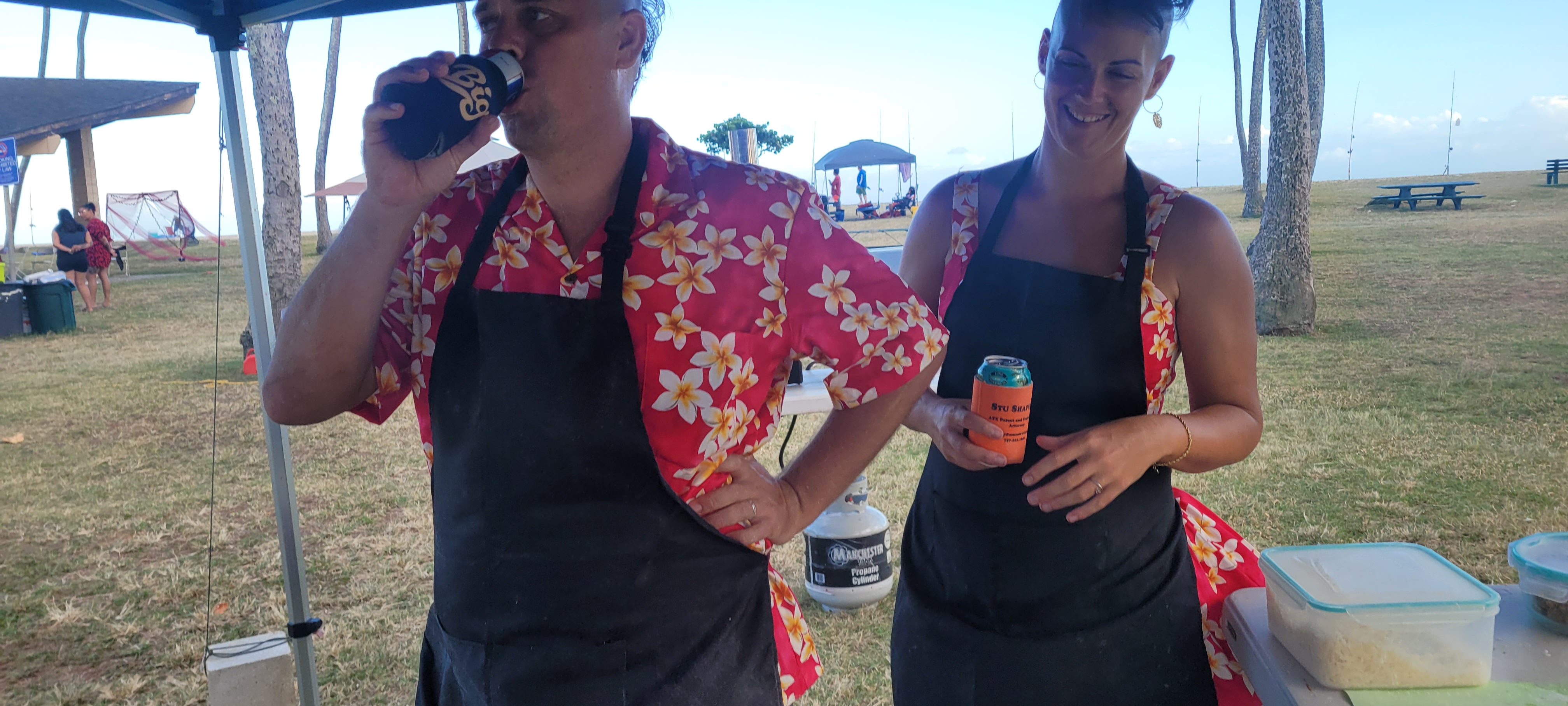
I get all the pizza stuff loaded into the back of the truck. We stop and fill propane at Waianae Store, get some ice. Luckily Hayley finds a couple black aprons so we don’t ruin our nice Aloha attire. If bruh wanted me in red and black he needed to tell me something more than two days before the ceremony. Our aloha shirt and dress are more pink than red. But it's what we’ve got.
I haven’t been all the way down to Ewa Beach for years. It's easy to forget how far it really is. We get there a little early, meant to be earlier to get set up but this things happening on island time so no sweat.
Hot day. Scope out the area of the park they got. Rented the pavilion for the ceremony and got a simple altar set up. Not too many people, maybe twenty when we arrive. All Kānaka maoli family. Like Kai’s family.
Go say hi to Adam, he’s looking nice and a little nervous. A black shirt with gold patterning. Wearing fancy shiny black shoes he says are killing his feet, can’t wait to get his slippas back on. He probably got them this week. He introduces us to his groomsmen, nice guys like Adam. Adam’s got a big heart. Like Kai’s heart.
Big Adam putting on his shirt for his wedding.
Hayley and I start setting up pizza making space and Adam and his groomsmen carry over a canopy for us. Solid guys. Great guys. Adam says he’s not too nervous but doesn’t like all the attention on him in front of everybody. I think he’s pretty nervous. It’s an annoying question to get on your wedding day, though. Thanks a lot Eileen.
After getting pizza stuff situated, we sign in and find seats near the back in the shade.
Hayley and Aron, getting ready for pizza making.
Uncle DJ is hilarious, doesn’t have much idea what’s going on or how to proceed, but is having a blast hearing himself talk.
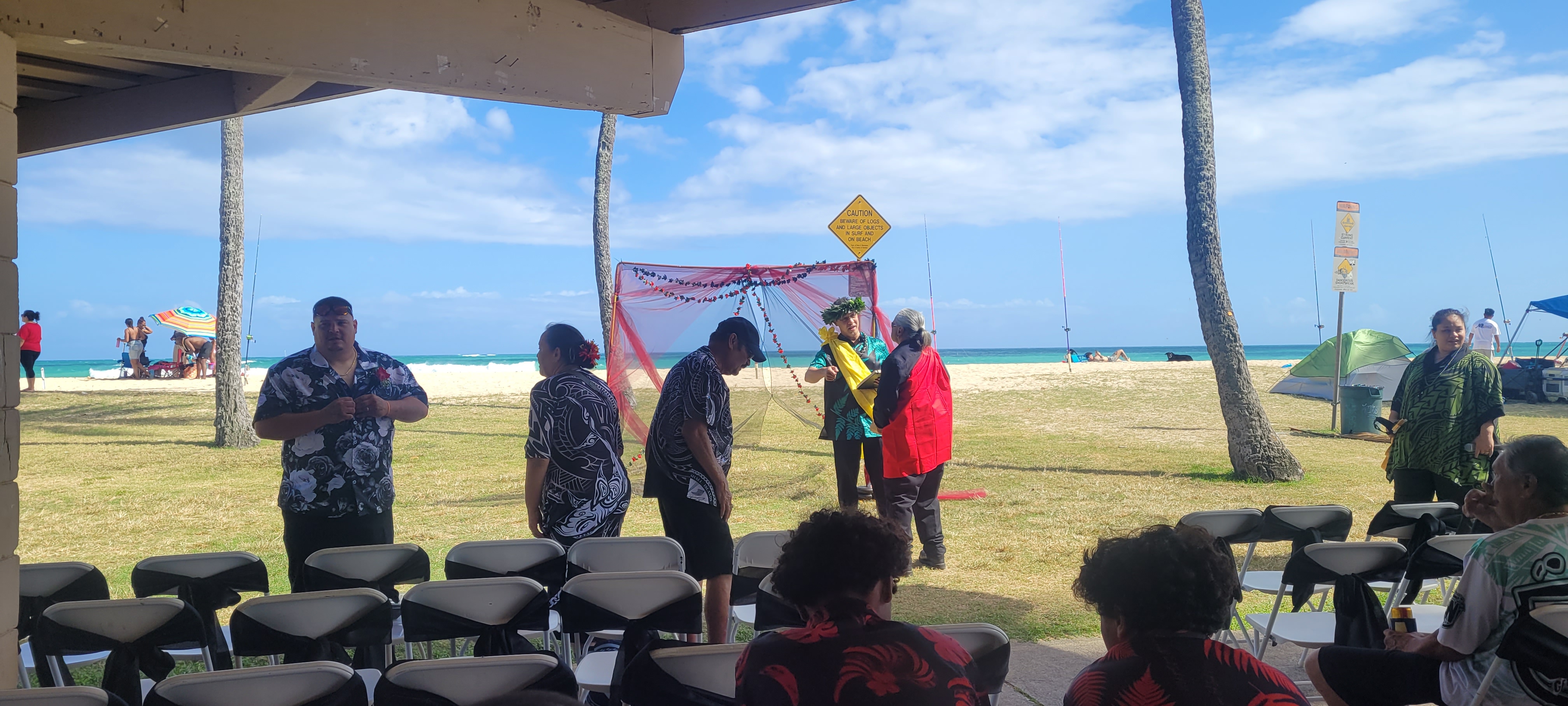
Ceremony starts, maybe fifty-ish people in attendance. Colors are red and black. Music starts and the couples are filling up the aisle.
Officiant starts with an oli.
Can’t hear what he’s saying to the couple. It's theirs to hear, not ours. There are two ladies with the officiant off to the side who sing and strum with him. Adam and Kawehi kiss. Short ceremony, Kai should be up there next to Adam. His best man. The best of us.
Then we move the chairs and tables to set up for eating. Go set up the pizza oven and stage all the materials - the prep station, cutting and boxing station, wash station. Fire up the oven to preheat.
Pizza is on!
Big Adam and Aron.
But then the wind and rains come in and we find out the hard way how much they cool off the oven. Struggling trying to cook our first couple pies. The steel isn’t hot enough, flame keeps going out. Still manage to cook some decent pies, it just takes a while. Once it gets to full heat, goes pretty smoothly, continuously making pizza all day until our 16 dough balls are gone. Take one break to watch the newlyweds cut the cake. It’s a chill wedding, people drinking beers and hanging around talking stories, eating pizza. There’s a raffle. And the chronics are running craps out back if you want to get down.
People are stoked on pizza. Keep asking for business cards. We don’t have any. One aunty wants us to cater her daughter’s graduation party in a year.
Pepperoni, homemade meatballs, and garlic eggplant. It’s all a hit. It's not fair that only the rich kids get special things for their weddings. Big Adam is trying the best he can, so we try to make it special for him. Each table gets to order a pizza of their choosing, we make it and then deliver.
Adam drops in every so often to say hi.
Nearing the end of our pizza stock but most of the crowd has smoked enough weed they all suddenly want more pizza. And the sun’s going down. Make our final pies in the dark, have to wrestle pizza boxes back from people to reuse.
Love Like Kai
Break down the setup, pack up the truck. Again, Adam’s groomsmen are there to help. Great guys. All of them. Hearts as big as the ocean with all the warmth of the sun.
Finally get to relax and spend a little time with Adam, Kawehi, and whoever is left drinking at the end. Kawehi thanks us for blessing them, I make sure to let her know it's from Kai. Adam wishes Kai could have been here. Caring for the people around us, the 'ohana of our choosing, it's what Kai would have us do. Our kaumaha, we carry the weight together. I can’t think of a better way to respect his memory than this.
References
1: Fedorowicz, S. C. (2013). Towards gonzo anthropology: Ethnography as cultural performance. Journal of Inquiry and Research, 98, 55–70. https://www.academia.edu/110338605/Towards_Gonzo_Anthropology_Ethnography_as_Cultural_Performance
↩︎
2: Thompson, H. S. (1966). Hell’s Angels: A strange and terrible saga. Random House.
↩︎
3: Liliʻuokalani, Queen. (1897). An account of the creation of the world according to Hawaiian tradition (The Kumulipo). Lee & Shepard.
↩︎
4: Krauss, B. H. (1993). Plants in Hawaiian Culture. Honolulu: University of Hawaii Press. Kupunakalo. (n.d.).
↩︎
5: Terrell, J. (2024, August 6). Community mourns death of Hawaiian activist and homeless advocate Twinkle Borge. Honolulu Civil Beat. https://www.civilbeat.org/2024/08/community-mourns-death-of-hawaiian-activist-and-homeless-advocate-twinkle-borge/
↩︎
6: Terrell, J. (2024, September 15). The Mother Teresa of Hawaii had an important lesson for us all. Honolulu Civil Beat. https://www.civilbeat.org/2024/09/the-mother-teresa-of-hawaii-had-an-important-lesson-for-us-all
↩︎
7: Puʻuhonua O Waiʻanae. (2025, March 11). Welcome home. https://www.puuhonuaowaianae.com/post/welcome-home
↩︎
8: Schuler, T. A. (2023, March). Place of refuge. Places Journal. https://doi.org/10.22269/230328
↩︎
9: Sojot, R. (2018, September 10). A place of refuge. FLUX Hawaii. https://fluxhawaii.com/largest-homeless-village-in-hawaii/
↩︎
10: Young, K. (2019). Home‑free and nothing (...)-less: A queer cosmology of aloha ʻāina. Hūlili: Multidisciplinary Research on Hawaiian Well‑Being, 11(1), 9–22. https://kamehamehapublishing.org/wp-content/uploads/sites/38/2020/09/Hulili_Vol11_1.pdf
↩︎
11: Dias, C. (2024, October 7). Getting to the root of violence in Waianae. Honolulu Civil Beat. https://www.civilbeat.org/2024/10/getting-to-the-root-of-violence-in-waianae/.
↩︎
12: Moke Manu. (1907). This Land is the Sea’s (T. G. Thrum, Trans.). In T. G. Thrum (Ed.), Hawaiian folk tales: A collection of native legends (pp. 203–214). A. C. McClurg & Co.
↩︎